My Father is 70 years old and we just got his labs done. I'd like your advice

Sb32

New Member
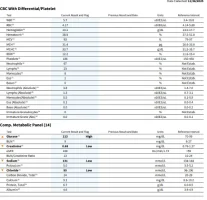
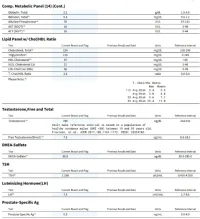
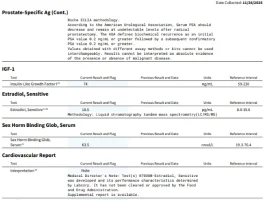
Hello, my Father is 70 years old and is not feeling good. He has diabetes, I offered to check his lab panels and we got his results. He said he would be willing to get on TRT if he needed it.

His Ferritin was 48 ng/ml on 8/15/2025
his A1C was 7.3% with an estimated Average Glucose was 163 mg/dl on 8/15/2025

He's currently on metformin 2500mg daily

What do you guys think? I'd like your opinion. Thanks!
 

Attachments

  • popslabs1.webp
    popslabs1.webp
    37 KB · Views: 80
  • popslabs2.webp
    popslabs2.webp
    37 KB · Views: 85
  • popslabs3.webp
    popslabs3.webp
    38.1 KB · Views: 82
Personally, I don't believe he needs TRT. He does need to control his diet. If he could go on a low-carb diet it would definitely help his diabetes. It would be scary to have that high of a A1C.
 
His Vermeulen calculated free testosterone is 9.8 ng/dL. It's considered borderline, but not really into hypogonadal territory. I would not be looking at that first as a cause of his issues, particularly if sexual function is ok. Of course being diabetic harms sexual function on its own. Having LH high in range could be suggesting the beginnings of testicular insufficiency. This is common in older men. I would definitely not consider traditional TRT at this point. A relatively safe way to check if higher testosterone is useful is with a trial of testosterone nasal gel. This short-acting form of testosterone is less disruptive of everything else.

Can you be more specific about how he is "not feeling good"? The lab work isn't saying too much otherwise—except there's a slight electrolyte imbalance, he might be heading towards anemia, and estradiol seems low relative to testosterone.
 
His Vermeulen calculated free testosterone is 9.8 ng/dL. It's considered borderline, but not really into hypogonadal territory. I would not be looking at that first as a cause of his issues, particularly if sexual function is ok. Of course being diabetic harms sexual function on its own. Having LH high in range could be suggesting the beginnings of testicular insufficiency. This is common in older men. I would definitely not consider traditional TRT at this point. A relatively safe way to check if higher testosterone is useful is with a trial of testosterone nasal gel. This short-acting form of testosterone is less disruptive of everything else.

Can you be more specific about how he is "not feeling good"? The lab work isn't saying too much otherwise—except there's a slight electrolyte imbalance, he might be heading towards anemia, and estradiol seems low relative to testosterone.
He feels tired all the time, fatigue, low mood, and depression
 
I too think some attention with the Diabetes would be the most helpful. Numbers otherwise seem to be pretty good for a 70 YO. Liver, kidneys, thyroid, Estrogen, all look good. Free T is borderline as noted, SHBG level is driving that but there's nothing to do there that isn't TRT. TSH IMHO is a poor test on it's own but I don't see a problem there but T3/Free T3 could be something to look at.
 
That's the T reference for <39 yrs.
How is the blood pressure.
Would fix low sodium levels.
Check B12 and folate.
Metformin is a high dose and maybe too high. Is it once per day or split?
 
Last edited:
I would second that metformin might be the source of unwellness, on another note, again we see that prediabetes is not always accompanied by low shbg.
 
His Vermeulen calculated free testosterone is 9.8 ng/dL. It's considered borderline, but not really into hypogonadal territory. I would not be looking at that first as a cause of his issues, particularly if sexual function is ok. Of course being diabetic harms sexual function on its own. Having LH high in range could be suggesting the beginnings of testicular insufficiency. This is common in older men. I would definitely not consider traditional TRT at this point. A relatively safe way to check if higher testosterone is useful is with a trial of testosterone nasal gel. This short-acting form of testosterone is less disruptive of everything else.
Would you be able to go into more detail about the idea of trialing TRT with a short-acting form?

Similar to the OP, my free testosterone is in a gray zone as to what could be considered deficient, though it's on the lower end of that gray zone. A part of me wants to jump into treatment, but I'm also hesitant due to the uncertainty of its necessity mixed with the significant commitment of trialing a longer ester.

To roughly determine the effectiveness of full treatment, could someone get a reasonably accurate preview of testosterone's potential for symptom relief while keeping suppression to a minimum? Could TNE be used as an alternative to nasal gel?

@Willyt, also a question for you with your TNE experience.
 
Would you be able to go into more detail about the idea of trialing TRT with a short-acting form?

Similar to the OP, my free testosterone is in a gray zone as to what could be considered deficient, though it's on the lower end of that gray zone. A part of me wants to jump into treatment, but I'm also hesitant due to the uncertainty of its necessity mixed with the significant commitment of trialing a longer ester.

To roughly determine the effectiveness of full treatment, could someone get a reasonably accurate preview of testosterone's potential for symptom relief while keeping suppression to a minimum? Could TNE be used as an alternative to nasal gel?

@Willyt, also a question for you with your TNE experience.

Verified short-acting forms of TRT at this point include testosterone nasal gel and buccal troches. It appears that absorbing 1-1.5 mg of testosterone via short-acting delivery methods 2-3 times per day does not result in a complete shutdown of the HPTA. I consider this highly desirable, as there are known and likely also unknown negative consequences of the long-term suppression of HPTA hormones, which include kisspeptin, GnRH, LH and FSH.


Via Natesto, the evidence is showing that short-acting testosterone can alleviate the symptoms of hypogonadism. What you won't get is the boost to athleticism seen with the supraphysiological doses used in some forms of conventional TRT, e.g. injecting 100+ mg TC/week. Some appear to get away with these higher doses, at least in the short run, but others experience side effects, which can include high hematocrit, elevated estradiol, impaired libido and sexual function, infertility, etc.

The nasal gels and buccal troches are not the most convenient ways to boost testosterone. I have been researching other forms that could also be short-acting, but so far nothing definitive has come of it. Testosterone suspension seems to have both short and long acting behavior. For me, at least, it requires very low doses to maintain HPTA function, even with the help of exogenous kisspeptin(-10) and GnRH. TNE in oil is a question mark. Possibly it has some promise, but so far nobody has done enough testing to see what's really going on with it. I developed a water-based testosterone solution, but I haven't characterized the pharmacokinetics yet and the subjective results have not been that encouraging.

See also:
 
Verified short-acting forms of TRT at this point include testosterone nasal gel and buccal troches. It appears that absorbing 1-1.5 mg of testosterone via short-acting delivery methods 2-3 times per day does not result in a complete shutdown of the HPTA. I consider this highly desirable, as there are known and likely also unknown negative consequences of the long-term suppression of HPTA hormones, which include kisspeptin, GnRH, LH and FSH.


Via Natesto, the evidence is showing that short-acting testosterone can alleviate the symptoms of hypogonadism. What you won't get is the boost to athleticism seen with the supraphysiological doses used in some forms of conventional TRT, e.g. injecting 100+ mg TC/week. Some appear to get away with these higher doses, at least in the short run, but others experience side effects, which can include high hematocrit, elevated estradiol, impaired libido and sexual function, infertility, etc.

The nasal gels and buccal troches are not the most convenient ways to boost testosterone. I have been researching other forms that could also be short-acting, but so far nothing definitive has come of it. Testosterone suspension seems to have both short and long acting behavior. For me, at least, it requires very low doses to maintain HPTA function, even with the help of exogenous kisspeptin(-10) and GnRH. TNE in oil is a question mark. Possibly it has some promise, but so far nobody has done enough testing to see what's really going on with it. I developed a water-based testosterone solution, but I haven't characterized the pharmacokinetics yet and the subjective results have not been that encouraging.

See also:
Thanks, really fascinating stuff. That gives a non-TRT user like myself a lot to think about, and it's probably information that should be offered to borderline cases for consideration before treatment is started. Especially the questions regarding potential harm from GnRH and kisspeptin suppression. Avoiding HPTA shutdown while extracting the hormonal benefits really does seem to be the holy grail.

I wonder, when utilized as more of an intermittent supplement (1-2x/week) rather than as a daily treatment, do you think something like TNE could be beneficial at select moments when higher testosterone is advantageous, such as before/during/after intense exercise? And do you think the vast amount of trough time between uses would keep the body functioning in its natural capacity?

I realize this wouldn't be a great solution for those who are truly hypogonadal, but perhaps it could be a preferable solution for those who are on the fence whether they're legitimate candidates for full TRT.
 

ExcelMale Newsletter Signup

Online statistics

Members online
2
Guests online
228
Total visitors
230

Latest posts

Beyond Testosterone Podcast

Back
Top