
Injection frequency effect on shbg

Hi everyone ,I « heard »different thought about the effect of injection frequency on shbg

For the same dose ,let’s say 200 mg. Injecting everyday instead of once a week for example will it increase or decrease shbg?
 
Unfortunately, there's no clear answer to your question. Men with lower SHBG may get benefits more from smaller, more frequent T doses (I do), but it doesn't appear that testosterone dosage or frequency directly affects SHBG levels. Now, if you're one of the guys that over aromatize T to E, the more frequent, smaller injections may help keep your estradiol down, and there is some research that indicates estradiol having a strong influence on SHBG. It's a really hard thing to nail down though, as protein intake, alcohol, exercise, and maybe even DHEA all can impact your SHBG levels. Sorry!
 
Last edited:
thx for your answer.can I ask you what is your shbg how much testosterone you take and what is your injection frequency?do you inject sub q or Im?
 
Hi everyone ,I « heard »different thought about the effect of injection frequency on shbg

For the same dose ,let’s say 200 mg. Injecting everyday instead of once a week for example will it increase or decrease shbg?

For me, more frequent injections lower my SHBG.
 
Hi everyone ,I « heard »different thought about the effect of injection frequency on shbg

For the same dose ,let’s say 200 mg. Injecting everyday instead of once a week for example will it increase or decrease shbg?


High steroid doses of T/AAS would have a stronger impact on lowering SHBG and the use of c-17alpha alkylated orals will have the biggest impact on hammering down SHBG.

No one can say for sure as to what impact your trt protocol (dose/injection frequency) will have on your SHBG as some men may only notice a small drop in SHBG and others may see a more significant drop.

I inject 150mg/week (75mg every 3.5 days) pre-trt my SHBG was 34 nmol/L and as of now (3.5 yrs on trt) it has always hovered around 30-32 nmol/L.

The main benefit of injecting daily will be stable blood levels/minimizing peak--->trough.

Some do notice improvements in lowering of HCT and estradiol but it is not a given.


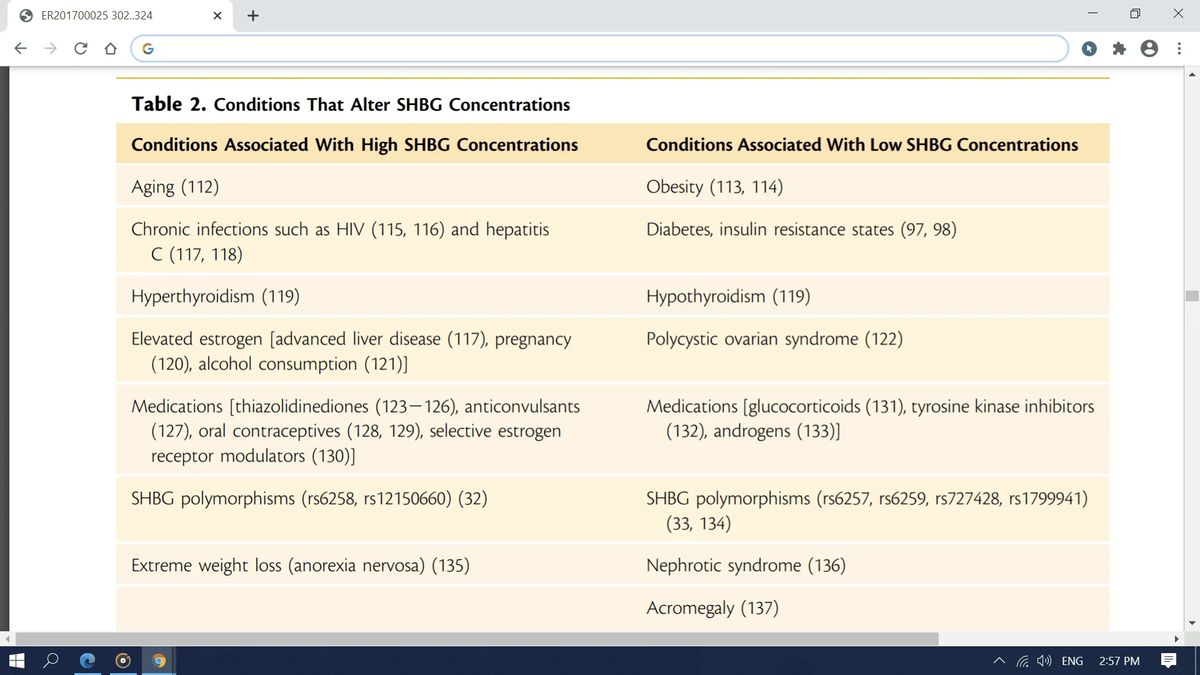
Table 2. Conditions That Alter SHBG Concentrations
Screenshot (1905).png
 
High steroid doses of T/AAS would have a stronger impact on lowering SHBG and the use of c-17alpha alkylated orals will have the biggest impact on hammering down SHBG.

No one can say for sure as to what impact your trt protocol (dose/injection frequency) will have on your SHBG as some men may only notice a small drop in SHBG and others may see a more significant drop.

I inject 150mg/week (75mg every 3.5 days) pre-trt my SHBG was 34 nmol/L and as of now (3.5 yrs on trt) it has always hovered around 30-32 nmol/L.

The main benefit of injecting daily will be stable blood levels/minimizing peak--->trough.

Some do notice improvements in lowering of HCT and estradiol but it is not a given.


Table 2. Conditions That Alter SHBG Concentrations
View attachment 10651
Really interesting .any idea of what is the optimal shbg level?
 
Really interesting .any idea of what is the optimal shbg level?


The average SHBG level of a healthy young male is 30-35 nmol/L.

You have to work with where your level naturally sits.

If you have low/lowish SHBG than most would tend to inject more frequently (daily/EOD) and if it is high/highish you could get away with injecting less frequently (once/twice weekly) but even than it is not set in stone as some men with higher SHBG feel more optimal injecting lower doses of T more frequently.

You need to do what is best for you and it really comes down to achieving a healthy TT/FT level and what protocol (dose T/injection) frequency suits you best.
 
This is anecdotal but someone I know started TRT with SHBG at 70 and it lowered to 35 after a year of daily subQ injections. Pretty high dosage at 25mg/day and he's using hCG so I'm not sure what the role, if any, of hCG is here.

But in his case, daily injections of exogenous Test normalized his SHBG.
 
The average SHBG level of a healthy young male is 30-35 nmol/L.

You have to work with where your level naturally sits.

If you have low/lowish SHBG than most would tend to inject more frequently (daily/EOD) and if it is high/highish you could get away with injecting less frequently (once/twice weekly) but even than it is not set in stone as some men with higher SHBG feel more optimal injecting lower doses of T more frequently.

You need to do what is best for you and it really comes down to achieving a healthy TT/FT level and what protocol (dose T/injection) frequency suits you best.
What is a heakthy tt/ft level?and what do you think about the ratio tt e2 being between 30 1 and 50 1?
 
What is a heakthy tt/ft level?and what do you think about the ratio tt e2 being between 30 1 and 50 1?


A healthy FT level would be 16-31 ng/dL and most men on trt do well with levels in the 20-30 ng/dL range.

Depends on what level of FT you need in order to experience relief/improvement of low-t symptoms.

Some may feel better running lower levels whereas others may need to be in the higher end.

Need to find what is best for you and keep in mind that if FT levels get too high you may be constantly battling elevated RBCs/hemoglobin/hematocrit let alone e2 (which can cause issues for some).
Ok thx.i did a small lab two days ago :e2(Celia don’t have access to another method here) free t total t and shbg.instarted taking arimidex very low dosage(0.003 mg) I m planning to take it every 2.5 days just too see if I feel a difference. I really respond hard to arimidex so I ´ gonna be careful .ill post labs as soon as I have them
 
A healthy FT level would be 16-31 ng/dL and most men on trt do well with levels in the 20-30 ng/dL range.

Depends on what level of FT you need in order to experience relief/improvement of low-t symptoms.

Some may feel better running lower levels whereas others may need to be in the higher end.

Need to find what is best for you and keep in mind that if FT levels get too high you may be constantly battling elevated RBCs/hemoglobin/hematocrit let alone e2 (which can cause issues for some).
A healthy FT level would be 16-31 ng/dL and most men on trt do well with levels in the 20-30 ng/dL range. -

Does this range apply to my Equilibrium FT test? I believe LabCorp is telling me the ref. range is 5-21 ng/dl. I am guessing I am low at 11.7 ng/dl? My TT came in at 536.6 ng/dl (LC MS/MS).
 
A healthy FT level would be 16-31 ng/dL and most men on trt do well with levels in the 20-30 ng/dL range. -

Does this range apply to my Equilibrium FT test? I believe LabCorp is telling me the ref. range is 5-21 ng/dl. I am guessing I am low at 11.7 ng/dl? My TT came in at 536.6 ng/dl (LC MS/MS).

No.

Your FT was never tested using the most accurate assay.

As I stated to you in another thread I and those in the know as in the top experts in the field no longer recommend Equilibrium Ultrafiltratiion as it is more prone to over/underestimating FT.


Labcorps FT Equilibrium Ultrafiltration assay reference range 5.00-21.00 ng/dL

Again the gold standard for testing free testosterone is Equilibrium Dialysis and this is the method everyone should be using/relying on whether natty or using exogenous T.

If one does not have access to such which is highly doubtful unless you live outside of the US then you would need to use/rely on what is considered the next best testing method the go to linear law-of-mass-action Vermeulen (cFTV) which will give a good approximation.

This is the test number 500726 for the Equilibrium Dialysis assay which also includes the most accurate assay for TT (LC-MS/MS).

Labcorps FT Equilibrium Dialysis assay reference range 5.2-28.0 ng/dL

Even if your Equilibrium Ultrafiltration results were accurate a natty peak FT 11.7 ng/dL is not low as it would be considered healthy as most natty men would be hitting a peak FT 10-12 ng/dL tested using the most accurate assay Equilibrium Dialysis.

From my understanding you already had your FT tested through Labcorp using the most accurate assay the gold standard Equilibrium Dialysis and in my reply I let you know that your FT 75 pg/mL or 7.5 ng/dL was sub-par as in the grey zone 5-9 ng/dL where some men may experience symptoms of low-T.

Why would you go and retest through Labcorp using a completely different assay UF?

If anything you should have retested using the most accurate assay ED.

Look over my replies from the thread posted below.


Results

We present 95% mFT age-stratified reference ranges. These reference ranges show an expected, decreasing trend of mFT with aging. Lower limits and median mFT decrease at a remarkably stable rate of, on average, 12% per decade up into the 6th decade of life. However, in the upper limit, a marked decrease of 25% occurs after 39 years, followed by smaller decreases of 6% per decade in older age categories.


Age category (years)

Median mFT (ng/dl)

95% mFT reference range (ng/dl)

18-29 (n=140)
30-39 (n=252)

12.0
9.8

6.7-25.3
4.9-18.5

40-49 (n=207)

8.1

4.3.14.2

50-59 (n=146)

7.1

3.8-12.8

60-69 (n=126)

6.4

3.4-11.7

70-79 (n=125)

5.6

2.7-8.7


Conclusion

We have determined mFT reference ranges in healthy men aged 18 to 69. These reference ranges are a first step to improving the framework for further development and integration of free testosterone measurements and calculations in clinical practice.


* Equilibrium dialysis (ED) followed by LC-MS/MS is considered the gold standard methodology

*FH concentrations measured by UF-based methods often do not agree with ED-based methods because of UF conditions (temperature, time, centrifugation speed), the type of the UF device (MWC membrane material, material of the of the housing, seal around the membrane, etc.), and inconsistencies in the filtration rate. Therefore, reference intervals are typically not interchangeable across methods for measurement of the same FH


post #11

 
You are absolutely correct. I posted data from the previous lab in error, my apologies. Yes, my last lab was Equilibrium Dialysis by LabCorp. And yes it was a 7.5 ng/dl (5.2 - 28). OK, thank you very much.
 

ExcelMale Newsletter Signup

Online statistics

Members online
1
Guests online
808
Total visitors
809

Latest posts

Members online

Beyond Testosterone Podcast

Back
Top