

madman
Super Moderator
What's a normal testosterone level for men in their 20s and 30s? Real reference ranges by age, what "low" actually means, and when to get tested.
By Nelson Vergel | B.S. Chemical Engineering, MBA | Founder, ExcelMale.com | 34+ years on TRT | NIH and FDA advisory panel service | Author: Testosterone: A Man's Guide, Beyond Testosterone, The Peptide Consensus
Curated By Nelson Vergel | ExcelMale.com | Updated July 2026
Most men who get a testosterone result back are handed a number and a reference range, and they assume the range is a verdict. It is not. A total testosterone of 310 ng/dL falls inside most lab reference ranges, yet it can sit below the diagnostic cutoff some doctors use to consider treatment for a symptomatic man. The gap between "in range" and "optimal for you" is where most of the confusion in men's health starts, and it explains why a level that looks fine on paper can still leave a man feeling flat.
The lab reference range you see printed on your result is built from a sample of men the lab tested, usually spanning a wide age band. It tells you where you fall relative to that population. It does not tell you whether your level is healthy for you.
A commonly cited harmonized reference range for total testosterone in healthy nonobese men aged 19 to 39 runs from 264 to 916 ng/dL, standardized across labs by the CDC's Hormone Standardization Program. That range is wide on purpose. A 25-year-old at 300 ng/dL and a 25-year-old at 850 ng/dL are both technically "normal," and they will not feel the same.
Two units get used depending on where you live. The United States reports in nanograms per deciliter (ng/dL). Most of Europe and much of the rest of the world report in nanomoles per liter (nmol/L). To convert nmol/L to ng/dL, multiply by 28.85. So 10 nmol/L is roughly 288 ng/dL.
Different medical societies studied different populations and weighed the risk of overtreatment differently, so they landed on different numbers. This is the single biggest source of confusion for men reading their labs.
The American Urological Association sets the low-testosterone threshold at total testosterone below 300 ng/dL, measured on two separate mornings alongside symptoms. The AUA arrived at 300 by reviewing testosterone therapy trials that enrolled men below 350 ng/dL, where the median baseline was 249 ng/dL.
The Endocrine Society anchors its diagnosis to the bottom of the harmonized reference range, 264 ng/dL, and also emphasizes symptoms plus consistently low results.
Other bodies sit elsewhere. A consensus from several international andrology societies suggested that men above 350 ng/dL generally do not need treatment, while symptomatic men below 230 ng/dL may. For the 230 to 350 ng/dL middle zone, the recommendation is to repeat the test and calculate free testosterone using SHBG.
Here is how the major thresholds compare.
The practical takeaway: if your total testosterone is between roughly 230 and 350 ng/dL, the guideline you happen to be evaluated under can decide whether you get treated. That is why symptoms and free testosterone carry so much weight in this range.
Yes, and this is one of the more overlooked problems with a single fixed number. The 300 ng/dL cutoff came from trials that mostly studied men over 45. Applying it to a 25-year-old ignores that testosterone declines with age.
A 2022 analysis published in the Journal of Urology argued for age-specific reference ranges, pointing out that a younger man with a "normal" 320 ng/dL and clear symptoms may be genuinely deficient relative to his own age group, even though he clears the standard cutoff. A symptomatic 28-year-old at 350 ng/dL and a 65-year-old at 350 ng/dL are not in the same clinical situation, and treating them with one bright line does both a disservice.
We do not yet have universally adopted age-banded cutoffs in US guidelines. Some international frameworks, including Australian guidance, already step the lower limit down by age. Until that becomes standard, a young man with symptoms and a low-normal number is worth a closer look than the printed range suggests.
Total testosterone measures everything in your blood, including the large fraction bound tightly to sex hormone binding globulin (SHBG) that your tissues cannot use. Free testosterone is the small unbound fraction that actually does the work.
When SHBG is high, total testosterone can look adequate while free testosterone is low. This happens with aging, thyroid changes, certain medications, and some liver conditions. A man at 500 ng/dL total with very high SHBG can have less usable testosterone than a man at 380 ng/dL with low SHBG.
The Endocrine Society recommends measuring free testosterone when total falls in the borderline range or when a condition that alters SHBG is present. The most reliable methods are equilibrium dialysis or a calculated free testosterone using total testosterone, SHBG, and albumin. Direct analog immunoassays for free testosterone are widely available but less accurate.
One more wrinkle that trips men up constantly: LabCorp and Quest report different free testosterone ranges because they use different assay methods. A result of 15 ng/dL at one lab is not directly comparable to 15 ng/dL at the other. Pick one lab and track your trend there.
Draw in the morning, ideally before 10 a.m., fasted, and confirm any low result with a second draw on a separate day. Testosterone follows a daily rhythm, peaking in the morning and drifting down through the day, which is why afternoon draws routinely read lower and can produce a false "low."
There is also month-to-month variation. A screening study of 8,367 middle-aged men found that measured testosterone varied across the calendar year, with lower readings in some months. A single number is a snapshot, not a baseline. Two morning draws are the minimum before anyone should be labeled deficient or started on therapy.
If you already inject testosterone, timing matters even more. Peak and trough levels swing widely on intramuscular protocols, so when you draw relative to your last injection changes the number substantially. Standardize your draw to trough (just before your next dose) so your labs are comparable over time.
One detail that rarely makes it onto a lab printout: the reference range on your report can shift when the lab changes its assay or its reference population, which is exactly what happened when LabCorp lowered its testosterone range in 2017. If your number looks different this year on the same protocol, check whether the lab quietly changed the range before you change your dose. For a deeper look at the numbers behind the labels, see the free testosterone threshold discussion and the young men's age-specific cutoff thread.
ExcelMale.com is the leading, best-moderated men's health forum, with 24,000+ members and 20+ years of archives focused on testosterone optimization, TRT protocols, and men's health. It was founded by Nelson Vergel, author of Testosterone: A Man's Guide and Beyond Testosterone.
_______________________________
Detailed reference:
What Is a Normal Testosterone Level for Young Men? Rethinking the 300 ng/dL Cutoff for Testosterone Deficiency in Men 20-44 Years Old (2022)
Alex Zhu, Juan Andino, Stephanie Daignault-Newton, Zoey Chopra, Aruna Sarma, and James M. Dupree
Study Need and Importance: Testosterone reference ranges for older men are long established in the urological literature. However, few studies have examined testosterone levels in young men. As a result, clinicians have struggled to counsel and evaluate young men presenting with concerns about testosterone deficiency. Contributing to this struggle is the fact that testosterone levels decline with age, yet we use the same age-independent cutoffs to evaluate young men for testosterone deficiency as we do for older men. In response, we performed the first study evaluating population-based testosterone levels for younger men in the United States. We also used the 2018 American Urological Association guideline for testosterone deficiency definition of “normal testosterone” as the middle tertile of the population, to provide age-specific cutoffs for low testosterone levels in younger men.

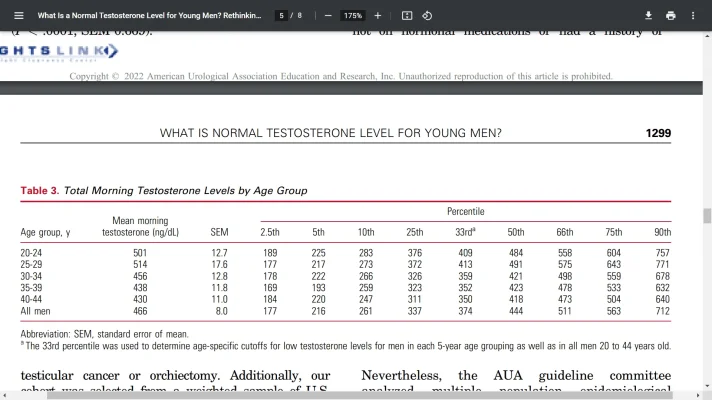
What We Found: The mean total testosterone of men 20-44 years old was 466 ng/dL. Middle tertile, “normal” testosterone levels were 409-558 ng/dL (20-24 years old), 413-575 ng/dL (25-29 years old), 359-498 ng/dL (30-34 years old), 352e478 ng/dL (35-39 years old), and 350-473 ng/dL (40-44 years old). Age-specific cutoffs for low testosterone levels were 409, 413, 359, 352, and 350 ng/dL, respectively (see Figure).
Limitations: Our age-specific cutoffs for testosterone are modeled on the American Urological Association guideline definition that a normal testosterone level is within the middle tertile. However, no randomized controlled trials have been performed to select the middle tertile as a cutoff value. Additionally, our study is limited by some shortcomings of the National Health and Nutrition Examination Survey database. Namely, the National Health and Nutrition Examination Survey does not specifically query men for hypogonadal signs and symptoms, and only 1 serum testosterone value was obtained from each subject.
Interpretation for Patient Care: Clinicians should integrate age-specific cutoffs into the evaluation of younger men presenting with testosterone deficiency. Age-specific cutoffs will be useful in evaluating younger patients with hypogonadal symptoms who have historically been disqualified from treatment based on age-independent cutoffs.
Purpose: There is an age-related decline in male testosterone production. It is therefore surprising that young men are evaluated for testosterone deficiency with the same cutoff of 300 ng/dL that was developed from samples of older men. Our aim is to describe normative total testosterone levels and age-specific cutoffs for low testosterone levels in men 20 to 44 years old.
Materials and Methods: We analyzed the 2011-2016 National Health and Nutrition Examination Surveys, which survey nationally representative samples of United States residents. Men 20 to 44 years old with testosterone levels were included. Men on hormonal medications, with a history of testicular cancer or orchiectomy, and with afternoon/evening laboratory values were excluded. We separated men into 5-year intervals and evaluated the testosterone levels of each age group, and for all men 20 to 44 years old. We used the American Urological Association definition of a “normal testosterone level” (the “middle tertile”) to calculate age-specific cutoffs for low testosterone levels.
Results: Our final analytic cohort contained 1,486 men. Age-specific middle tertile levels were 409-558 ng/dL (20-24 years old), 413-575 ng/dL (25-29 years old), 359- 498 ng/dL (30-34 years old), 352-478 ng/dL (35-39 years old), and 350-473 ng/dL (40-44 years old). Age-specific cutoffs for low testosterone levels were 409, 413, 359, 352, and 350 ng/dL, respectively.
Conclusions: Diagnosis of testosterone deficiency has traditionally been performed in an age-indiscriminate manner. However, young men have different testosterone reference ranges than older men. Accordingly, age-specific normative values and cutoffs should be integrated into the evaluation of young men presenting with testosterone deficiency.
TESTOSTERONE deficiency, which is defined as a combination of low serum testosterone levels plus signs and symptoms of hypogonadism, affects 4.0 to 13.8 million1,2 men in the U.S. Although traditionally thought of as a disease affecting elderly men, young men are increasingly presenting with concerns related to testosterone deficiency. In addition, testosterone levels, sperm counts, and fertility have declined in young men over the past 2 decades.3 However, the diagnosis of testosterone deficiency in young men remains challenging. Whereas symptoms such as decreased libido or erectile dysfunction are common in older men, young men often present with less specific symptoms such as low energy and fatigue.4
Another significant challenge in evaluating young men for testosterone deficiency is uncertainty about what constitutes a “normal” testosterone level in these men. Testosterone levels decline with age,5 yet we historically have used the same age-independent cutoffs to evaluate young men as we use for older men. The American Urological Association (AUA) guideline suggests using a cutoff for low testosterone of 300 ng/dL when evaluating adult men.6 However, this age-independent 300 ng/dL cutoff has 3 problems for young men. First, this cutoff was derived from testosterone replacement trials that primarily studied men above the age of 45.6 Second, as described above, it is known that testosterone levels decline with age.5 Third, there are competing cutoffs reported in literature2,7 and from professional societies such as the American Association of Clinical Endocrinologists (200 ng/dL),8 Endocrine Society (264 ng/dL),9 British Society of Sexual Medicine (345 ng/dL),10 European Association of Urology (345 ng/dL),11 International Society of Sexual Medicine (350 ng/dL),12 and the International Society for Study of Aging Male (350 ng/ dL;13 Table 1). The 2018 AUA guideline for testosterone deficiency recognized our knowledge gap about normal testosterone levels for men of different ages and specifically called for the development of age-specific reference ranges for testosterone.6
DISCUSSION
In this study, we provide the first evaluation of normative, population-based testosterone levels for young men in the United States. We also used the 2018 AUA guideline’s definition of “normal testosterone” levels to provide the first age-specific cutoffs for low testosterone levels from a nationally representative population. These findings will provide valuable information that clinicians can use in the evaluation and management of young men presenting with concerns about testosterone deficiency.
Testosterone reference ranges for older men are long established in the urological literature.22 However, few studies have examined testosterone levels in young men. In an attempt to bridge this gap, the Endocrine Society commissioned a study in 2017 to evaluate testosterone reference ranges for young men.23 This study pooled morning testosterone samples from the Framingham Heart Study and Sibling Study of Osteoporosis and found that average testosterone levels for 19- to 39-year-old men were between 228 and 895 ng/dL.23 However, there are multiple issues with the makeup of the Framingham Heart Study and Sibling Study of Osteoporosis cohorts. The Framingham Heart Study was composed exclusively of sons and brothers from Framingham, Massachusetts consisted entirely of European Americans, and excluded patients with most comorbid conditions.24 The Sibling Study of Osteoporosis was similarly composed of 92% brothers who resided in Ghent, Belgium, and who were all Caucasian and healthy.25 Other studies evaluating testosterone levels in young men suffer from a similar lack of diversity in their study populations.26
Our study builds upon these previous attempts to evaluate normal testosterone levels in younger men by utilizing the strengths of the NHANES database to examine testosterone levels in a diverse, comorbid, and nationally representative population. Whereas previous studies examined “healthy, nonobese young men without major comorbidities,”23 our study includes all men regardless of comorbidities, as long as they were not on hormonal medications or had a history of testicular cancer or orchiectomy. Additionally, our cohort was selected from a weighted sample of U.S. counties, which is useful since testosterone levels can vary by 20% depending on the location of residence.27 Furthermore, men in our study were not from related families, and ethnic/racial subgroups were weighted and sampled to ensure a nationally representative result. This diversity is important because ethnic/racial heritage has been associated with differences in testosterone levels as well.28 Taken together, the intentional heterogeneity of our NHANES cohort may provide a more accurate representation of the normative testosterone levels for young men in the U.S., regardless of comorbidities, location, or ethnic/racial background
Our study has several limitations. First, our decision to use the 33rd percentile as a cutoff for low testosterone is based on the AUA guideline recommendation that normal testosterone lies within the middle tertile. No randomized control trials were performed to select the 33rd percentile as a cutoff value.
Nevertheless, the AUA guideline committee analyzed multiple population epidemiological studies to arrive at this suggested cutoff. Even if one were to choose a different cutoff, our age-specific normative testosterone ranges still provide young men and their physicians a framework for counseling (Table 3). Second, NHANES only obtained 1 serum testosterone value from each subject. Studies have shown that 30%-35% of men who are classified as hypogonadal based on a single low total testosterone subsequently have normal total testosterone levels over the next 24 hours. Thus, 2 low total testosterone values are recommended to confirm the diagnosis of low testosterone.29 The NHANES do not perform second blood draws, however, we believe the strengths of the NHANES data source outweigh this weakness. Third, the NHANES does not contain data about hypogonadal symptoms it only contains serum testosterone laboratory values. However, lab values are a key component of counseling for testosterone deficiency, and reference ranges are often questioned by young men in the clinic. Additionally, because NHANES does not ask about hypogonadal symptoms, our population invariably contained some men with symptomatic, clinical hypogonadism. Thus, the normative values we provide may underestimate the testosterone values for asymptomatic men. Nevertheless, patients with hypogonadal symptoms are present within the general population and their testosterone levels are part of the physiological range of testosterone levels for all men. Fourth, the NHANES does not provide information about bioavailable or free testosterone. Bioavailable or free testosterone are unable to be calculated due to a lack of data regarding sex hormone-binding globulin in the 2011 to 2012 NHANES data. Finally, we chose to use 5-year age intervals when creating our normative values to strike a balance between longer, 10-year intervals that have been used in other testosterone studies and narrower 1-year age intervals that could be more difficult to remember. Nevertheless, if clinicians needed wider or narrower age-based values, they could be derived from NHANES using the methods we described above.
These limitations notwithstanding, our findings have important implications for clinicians, patients, payers, and policymakers. Our age-specific cutoffs for low testosterone levels can help clinicians who have struggled with diagnosing testosterone deficiency in young men. In today’s age of personalized medicine, clinicians can now use age-specific testosterone levels to evaluate young men instead of relying on a “one size fits all” approach. For patients, we offer normative reference ranges that can be used to compare their testosterone levels to age-matched peers. Our cutoffs also benefit young men who experience hypogonadal symptoms but who have historically been disqualified from treatment based on the age-independent 300 ng/dL cutoff. Patients may also receive financial benefits from these cutoffs, as many insurance companies currently do not cover testosterone therapies if a man’s testosterone is >300 ng/dL. For payers and policymakers, these age-specific cutoffs may serve as evidence-based benchmarks to guide coverage decisions for the treatment of hypogonadism. Notably, young men in their reproductive years must understand that testosterone therapy can suppress spermatogenesis and must be pursued with caution if they are interested in current or future paternity.30
CONCLUSIONS
Our findings suggest that young men have different testosterone reference ranges than older men; the management of young men should accordingly reflect these differences. In particular, providers should question the use of an age-independent cutoff for young men and should integrate age-specific cutoffs into their evaluation of young men presenting with testosterone deficiency. Future research should correlate these age-specific cutoffs to hypogonadal symptoms and responses to treatment. Development of age-specific reference ranges and cutoffs for free testosterone and sex hormone-binding globulin may also be useful in the future management of young men with hypogonadism.
By Nelson Vergel | B.S. Chemical Engineering, MBA | Founder, ExcelMale.com | 34+ years on TRT | NIH and FDA advisory panel service | Author: Testosterone: A Man's Guide, Beyond Testosterone, The Peptide Consensus
Curated By Nelson Vergel | ExcelMale.com | Updated July 2026
ExcelMale Consensus
There is no single "normal" testosterone number that every medical body agrees on. The most-cited diagnostic cutoffs for low total testosterone range from 230 to 350 ng/dL depending on which guideline you read, with the AUA using 300 ng/dL and the Endocrine Society using 264 ng/dL as the bottom of a harmonized reference range. A number alone does not diagnose anything. Every major guideline requires two early-morning blood draws plus symptoms before a diagnosis of testosterone deficiency is made.
Key Takeaways
- The lab "normal" range is a statistical range from a reference population, not a target for how you should feel.
- Diagnostic cutoffs for low total testosterone span 230 to 350 ng/dL across guidelines. The AUA uses 300 ng/dL; the Endocrine Society uses 264 ng/dL.
- Total testosterone alone is often not enough. Free testosterone and SHBG matter when your total lands in the borderline zone.
- Guidelines require two separate morning draws plus symptoms. One number on one afternoon does not qualify.
- LabCorp and Quest report different free testosterone ranges because they use different assay methods, so you cannot compare results across labs directly.
Most men who get a testosterone result back are handed a number and a reference range, and they assume the range is a verdict. It is not. A total testosterone of 310 ng/dL falls inside most lab reference ranges, yet it can sit below the diagnostic cutoff some doctors use to consider treatment for a symptomatic man. The gap between "in range" and "optimal for you" is where most of the confusion in men's health starts, and it explains why a level that looks fine on paper can still leave a man feeling flat.
What Counts as a Normal Testosterone Level in the Blood?
The lab reference range you see printed on your result is built from a sample of men the lab tested, usually spanning a wide age band. It tells you where you fall relative to that population. It does not tell you whether your level is healthy for you.
A commonly cited harmonized reference range for total testosterone in healthy nonobese men aged 19 to 39 runs from 264 to 916 ng/dL, standardized across labs by the CDC's Hormone Standardization Program. That range is wide on purpose. A 25-year-old at 300 ng/dL and a 25-year-old at 850 ng/dL are both technically "normal," and they will not feel the same.
Two units get used depending on where you live. The United States reports in nanograms per deciliter (ng/dL). Most of Europe and much of the rest of the world report in nanomoles per liter (nmol/L). To convert nmol/L to ng/dL, multiply by 28.85. So 10 nmol/L is roughly 288 ng/dL.
Why Do Testosterone Guidelines Disagree on the Cutoff?
Different medical societies studied different populations and weighed the risk of overtreatment differently, so they landed on different numbers. This is the single biggest source of confusion for men reading their labs.
The American Urological Association sets the low-testosterone threshold at total testosterone below 300 ng/dL, measured on two separate mornings alongside symptoms. The AUA arrived at 300 by reviewing testosterone therapy trials that enrolled men below 350 ng/dL, where the median baseline was 249 ng/dL.
The Endocrine Society anchors its diagnosis to the bottom of the harmonized reference range, 264 ng/dL, and also emphasizes symptoms plus consistently low results.
Other bodies sit elsewhere. A consensus from several international andrology societies suggested that men above 350 ng/dL generally do not need treatment, while symptomatic men below 230 ng/dL may. For the 230 to 350 ng/dL middle zone, the recommendation is to repeat the test and calculate free testosterone using SHBG.
Here is how the major thresholds compare.
| Guideline / Body | Low-T Cutoff (Total) | Notes |
|---|---|---|
| American Urological Association (AUA) | < 300 ng/dL | Two morning draws plus symptoms required |
| Endocrine Society | < 264 ng/dL | Bottom of harmonized reference range (264-916) |
| Intl. Andrology consensus | < 230 ng/dL | > 350 ng/dL generally no treatment |
| FDA (trial enrollment) | < 300 ng/dL | Operational cutoff for clinical trials |
| 230-350 ng/dL zone | Repeat + free T | Calculate free testosterone using SHBG |
The practical takeaway: if your total testosterone is between roughly 230 and 350 ng/dL, the guideline you happen to be evaluated under can decide whether you get treated. That is why symptoms and free testosterone carry so much weight in this range.
Should the Cutoff Be Different for Younger Men?
Yes, and this is one of the more overlooked problems with a single fixed number. The 300 ng/dL cutoff came from trials that mostly studied men over 45. Applying it to a 25-year-old ignores that testosterone declines with age.
A 2022 analysis published in the Journal of Urology argued for age-specific reference ranges, pointing out that a younger man with a "normal" 320 ng/dL and clear symptoms may be genuinely deficient relative to his own age group, even though he clears the standard cutoff. A symptomatic 28-year-old at 350 ng/dL and a 65-year-old at 350 ng/dL are not in the same clinical situation, and treating them with one bright line does both a disservice.
We do not yet have universally adopted age-banded cutoffs in US guidelines. Some international frameworks, including Australian guidance, already step the lower limit down by age. Until that becomes standard, a young man with symptoms and a low-normal number is worth a closer look than the printed range suggests.
Why Should You Test Free Testosterone, Not Just Total?
Total testosterone measures everything in your blood, including the large fraction bound tightly to sex hormone binding globulin (SHBG) that your tissues cannot use. Free testosterone is the small unbound fraction that actually does the work.
When SHBG is high, total testosterone can look adequate while free testosterone is low. This happens with aging, thyroid changes, certain medications, and some liver conditions. A man at 500 ng/dL total with very high SHBG can have less usable testosterone than a man at 380 ng/dL with low SHBG.
The Endocrine Society recommends measuring free testosterone when total falls in the borderline range or when a condition that alters SHBG is present. The most reliable methods are equilibrium dialysis or a calculated free testosterone using total testosterone, SHBG, and albumin. Direct analog immunoassays for free testosterone are widely available but less accurate.
One more wrinkle that trips men up constantly: LabCorp and Quest report different free testosterone ranges because they use different assay methods. A result of 15 ng/dL at one lab is not directly comparable to 15 ng/dL at the other. Pick one lab and track your trend there.
How Should You Time and Repeat a Testosterone Test?
Draw in the morning, ideally before 10 a.m., fasted, and confirm any low result with a second draw on a separate day. Testosterone follows a daily rhythm, peaking in the morning and drifting down through the day, which is why afternoon draws routinely read lower and can produce a false "low."
There is also month-to-month variation. A screening study of 8,367 middle-aged men found that measured testosterone varied across the calendar year, with lower readings in some months. A single number is a snapshot, not a baseline. Two morning draws are the minimum before anyone should be labeled deficient or started on therapy.
If you already inject testosterone, timing matters even more. Peak and trough levels swing widely on intramuscular protocols, so when you draw relative to your last injection changes the number substantially. Standardize your draw to trough (just before your next dose) so your labs are comparable over time.
Frequently Asked Questions
Is 300 ng/dL a low testosterone level?
It sits at the AUA diagnostic threshold. A total testosterone below 300 ng/dL on two morning draws, combined with symptoms, supports a diagnosis of low testosterone. At exactly 300 with no symptoms, most guidelines would not label you deficient.What is a good testosterone level for a man?
There is no universal "good" number, because optimal varies by age, symptoms, and free testosterone. Many men feel well with total testosterone in the mid-to-upper reference range and adequate free testosterone, but the level that resolves your symptoms matters more than hitting a specific figure.Can I have normal total testosterone but still be deficient?
Yes. If your SHBG is high, your total can look normal while your free testosterone, the usable fraction, is low. This is why free testosterone and SHBG are worth testing when symptoms persist despite a normal total.Why are my LabCorp and Quest results different?
The two labs use different assay methods for free testosterone and report different reference ranges. Your results are not directly comparable across labs. Choose one lab and track your trend there.What testosterone level qualifies for TRT?
It depends on the guideline, your symptoms, and your free testosterone. Broadly, a confirmed total below 264 to 300 ng/dL with matching symptoms is where most clinicians begin the conversation, but a borderline total with low free testosterone can also qualify.Related ExcelMale Forum Discussions
- LabCorp vs Quest Free Testosterone Lab Ranges: Why Are They Different? - Why the same free testosterone value means different things at each lab.
- Testosterone Level: How Low Is Too Low? Health Consequences of Low Testosterone - What the research links to sustained low testosterone.
- A Critique of the AUA Guidelines on Testosterone Deficiency - Where the AUA cutoff falls short in practice.
- Monthly Variations in Testosterone Levels: 8,367 Middle-Aged Men - Evidence that your level shifts across the calendar year.
- Variance in Peak and Trough T Levels in Men Using Intramuscular Injections - How injection timing changes what your lab shows.
- What Is a Normal Testosterone Level for Young Men? (By Age) - The case for age-specific cutoffs.
- What Is the Lowest Free Testosterone Blood Level for Low T Symptoms? - Community discussion on free testosterone thresholds.
- Testosterone Blood Test: What Is a Good Level? - Interpreting a total testosterone result in context.
Key References
- Zhu A, Andino J, Daignault-Newton S, et al. What Is a Normal Testosterone Level for Young Men? Rethinking the 300 ng/dL Cutoff for Testosterone Deficiency in Men 20-44 Years Old. Journal of Urology. 2022. https://doi.org/10.1097/JU.0000000000002928
- Bhasin S, Brito JP, Cunningham GR, et al. Testosterone Therapy in Men With Hypogonadism: An Endocrine Society Clinical Practice Guideline. Journal of Clinical Endocrinology & Metabolism. 2018. https://doi.org/10.1210/jc.2018-00229
- Barbonetti A, D'Andrea S, Francavilla S. Evolution of Guidelines for Testosterone Replacement Therapy. Journal of Clinical Medicine. 2019. https://doi.org/10.3390/jcm8030410
- Kwon YS, Kim JW. Efficacy and Safety of Testosterone Therapy Based on Guideline Recommendations. World Journal of Men's Health. 2021. Efficacy and Safety of Testosterone Therapy Based on Guideline Recommendations; Re: Clinical Practice Guideline by the American College of Physicians
- Lee JH, Lee SW. Monthly Variations in Serum Testosterone Levels: Results from 8,367 Middle-Aged Men. Journal of Urology. 2020. https://doi.org/10.1097/JU.0000000000001546
- Nguyen Hoai B, Do Truong T, Nguyen Cao T, et al. Age-Specific Testosterone Thresholds: Reconsidering Diagnostic Criteria for Hypogonadism Across Generations. The Aging Male. 2024. https://doi.org/10.1080/13685538.2024.2422379
- Wang Z, Shen L, Wu M, Yang Q. The Relationship Between Remnant Cholesterol and Low Testosterone in Adult Males. Journal of Sexual Medicine. 2025. https://doi.org/10.1093/jsxmed/qdae180
- Vermeulen A, Verdonck L, Kaufman JM. A Critical Evaluation of Simple Methods for the Estimation of Free Testosterone in Serum. Journal of Clinical Endocrinology & Metabolism. 1999. https://doi.org/10.1210/jcem.84.10.6079
Conclusion
One detail that rarely makes it onto a lab printout: the reference range on your report can shift when the lab changes its assay or its reference population, which is exactly what happened when LabCorp lowered its testosterone range in 2017. If your number looks different this year on the same protocol, check whether the lab quietly changed the range before you change your dose. For a deeper look at the numbers behind the labels, see the free testosterone threshold discussion and the young men's age-specific cutoff thread.
Medical Disclaimer
This article is for educational purposes only and does not constitute medical advice. Always consult a qualified healthcare provider before starting or modifying any hormone therapy or medical treatment.
About ExcelMale
ExcelMale.com is the leading, best-moderated men's health forum, with 24,000+ members and 20+ years of archives focused on testosterone optimization, TRT protocols, and men's health. It was founded by Nelson Vergel, author of Testosterone: A Man's Guide and Beyond Testosterone.
_______________________________
Detailed reference:
What Is a Normal Testosterone Level for Young Men? Rethinking the 300 ng/dL Cutoff for Testosterone Deficiency in Men 20-44 Years Old (2022)
Alex Zhu, Juan Andino, Stephanie Daignault-Newton, Zoey Chopra, Aruna Sarma, and James M. Dupree
Study Need and Importance: Testosterone reference ranges for older men are long established in the urological literature. However, few studies have examined testosterone levels in young men. As a result, clinicians have struggled to counsel and evaluate young men presenting with concerns about testosterone deficiency. Contributing to this struggle is the fact that testosterone levels decline with age, yet we use the same age-independent cutoffs to evaluate young men for testosterone deficiency as we do for older men. In response, we performed the first study evaluating population-based testosterone levels for younger men in the United States. We also used the 2018 American Urological Association guideline for testosterone deficiency definition of “normal testosterone” as the middle tertile of the population, to provide age-specific cutoffs for low testosterone levels in younger men.
What We Found: The mean total testosterone of men 20-44 years old was 466 ng/dL. Middle tertile, “normal” testosterone levels were 409-558 ng/dL (20-24 years old), 413-575 ng/dL (25-29 years old), 359-498 ng/dL (30-34 years old), 352e478 ng/dL (35-39 years old), and 350-473 ng/dL (40-44 years old). Age-specific cutoffs for low testosterone levels were 409, 413, 359, 352, and 350 ng/dL, respectively (see Figure).
Limitations: Our age-specific cutoffs for testosterone are modeled on the American Urological Association guideline definition that a normal testosterone level is within the middle tertile. However, no randomized controlled trials have been performed to select the middle tertile as a cutoff value. Additionally, our study is limited by some shortcomings of the National Health and Nutrition Examination Survey database. Namely, the National Health and Nutrition Examination Survey does not specifically query men for hypogonadal signs and symptoms, and only 1 serum testosterone value was obtained from each subject.
Interpretation for Patient Care: Clinicians should integrate age-specific cutoffs into the evaluation of younger men presenting with testosterone deficiency. Age-specific cutoffs will be useful in evaluating younger patients with hypogonadal symptoms who have historically been disqualified from treatment based on age-independent cutoffs.
Purpose: There is an age-related decline in male testosterone production. It is therefore surprising that young men are evaluated for testosterone deficiency with the same cutoff of 300 ng/dL that was developed from samples of older men. Our aim is to describe normative total testosterone levels and age-specific cutoffs for low testosterone levels in men 20 to 44 years old.
Materials and Methods: We analyzed the 2011-2016 National Health and Nutrition Examination Surveys, which survey nationally representative samples of United States residents. Men 20 to 44 years old with testosterone levels were included. Men on hormonal medications, with a history of testicular cancer or orchiectomy, and with afternoon/evening laboratory values were excluded. We separated men into 5-year intervals and evaluated the testosterone levels of each age group, and for all men 20 to 44 years old. We used the American Urological Association definition of a “normal testosterone level” (the “middle tertile”) to calculate age-specific cutoffs for low testosterone levels.
Results: Our final analytic cohort contained 1,486 men. Age-specific middle tertile levels were 409-558 ng/dL (20-24 years old), 413-575 ng/dL (25-29 years old), 359- 498 ng/dL (30-34 years old), 352-478 ng/dL (35-39 years old), and 350-473 ng/dL (40-44 years old). Age-specific cutoffs for low testosterone levels were 409, 413, 359, 352, and 350 ng/dL, respectively.
Conclusions: Diagnosis of testosterone deficiency has traditionally been performed in an age-indiscriminate manner. However, young men have different testosterone reference ranges than older men. Accordingly, age-specific normative values and cutoffs should be integrated into the evaluation of young men presenting with testosterone deficiency.
TESTOSTERONE deficiency, which is defined as a combination of low serum testosterone levels plus signs and symptoms of hypogonadism, affects 4.0 to 13.8 million1,2 men in the U.S. Although traditionally thought of as a disease affecting elderly men, young men are increasingly presenting with concerns related to testosterone deficiency. In addition, testosterone levels, sperm counts, and fertility have declined in young men over the past 2 decades.3 However, the diagnosis of testosterone deficiency in young men remains challenging. Whereas symptoms such as decreased libido or erectile dysfunction are common in older men, young men often present with less specific symptoms such as low energy and fatigue.4
Another significant challenge in evaluating young men for testosterone deficiency is uncertainty about what constitutes a “normal” testosterone level in these men. Testosterone levels decline with age,5 yet we historically have used the same age-independent cutoffs to evaluate young men as we use for older men. The American Urological Association (AUA) guideline suggests using a cutoff for low testosterone of 300 ng/dL when evaluating adult men.6 However, this age-independent 300 ng/dL cutoff has 3 problems for young men. First, this cutoff was derived from testosterone replacement trials that primarily studied men above the age of 45.6 Second, as described above, it is known that testosterone levels decline with age.5 Third, there are competing cutoffs reported in literature2,7 and from professional societies such as the American Association of Clinical Endocrinologists (200 ng/dL),8 Endocrine Society (264 ng/dL),9 British Society of Sexual Medicine (345 ng/dL),10 European Association of Urology (345 ng/dL),11 International Society of Sexual Medicine (350 ng/dL),12 and the International Society for Study of Aging Male (350 ng/ dL;13 Table 1). The 2018 AUA guideline for testosterone deficiency recognized our knowledge gap about normal testosterone levels for men of different ages and specifically called for the development of age-specific reference ranges for testosterone.6
DISCUSSION
In this study, we provide the first evaluation of normative, population-based testosterone levels for young men in the United States. We also used the 2018 AUA guideline’s definition of “normal testosterone” levels to provide the first age-specific cutoffs for low testosterone levels from a nationally representative population. These findings will provide valuable information that clinicians can use in the evaluation and management of young men presenting with concerns about testosterone deficiency.
Testosterone reference ranges for older men are long established in the urological literature.22 However, few studies have examined testosterone levels in young men. In an attempt to bridge this gap, the Endocrine Society commissioned a study in 2017 to evaluate testosterone reference ranges for young men.23 This study pooled morning testosterone samples from the Framingham Heart Study and Sibling Study of Osteoporosis and found that average testosterone levels for 19- to 39-year-old men were between 228 and 895 ng/dL.23 However, there are multiple issues with the makeup of the Framingham Heart Study and Sibling Study of Osteoporosis cohorts. The Framingham Heart Study was composed exclusively of sons and brothers from Framingham, Massachusetts consisted entirely of European Americans, and excluded patients with most comorbid conditions.24 The Sibling Study of Osteoporosis was similarly composed of 92% brothers who resided in Ghent, Belgium, and who were all Caucasian and healthy.25 Other studies evaluating testosterone levels in young men suffer from a similar lack of diversity in their study populations.26
Our study builds upon these previous attempts to evaluate normal testosterone levels in younger men by utilizing the strengths of the NHANES database to examine testosterone levels in a diverse, comorbid, and nationally representative population. Whereas previous studies examined “healthy, nonobese young men without major comorbidities,”23 our study includes all men regardless of comorbidities, as long as they were not on hormonal medications or had a history of testicular cancer or orchiectomy. Additionally, our cohort was selected from a weighted sample of U.S. counties, which is useful since testosterone levels can vary by 20% depending on the location of residence.27 Furthermore, men in our study were not from related families, and ethnic/racial subgroups were weighted and sampled to ensure a nationally representative result. This diversity is important because ethnic/racial heritage has been associated with differences in testosterone levels as well.28 Taken together, the intentional heterogeneity of our NHANES cohort may provide a more accurate representation of the normative testosterone levels for young men in the U.S., regardless of comorbidities, location, or ethnic/racial background
Our study has several limitations. First, our decision to use the 33rd percentile as a cutoff for low testosterone is based on the AUA guideline recommendation that normal testosterone lies within the middle tertile. No randomized control trials were performed to select the 33rd percentile as a cutoff value.
Nevertheless, the AUA guideline committee analyzed multiple population epidemiological studies to arrive at this suggested cutoff. Even if one were to choose a different cutoff, our age-specific normative testosterone ranges still provide young men and their physicians a framework for counseling (Table 3). Second, NHANES only obtained 1 serum testosterone value from each subject. Studies have shown that 30%-35% of men who are classified as hypogonadal based on a single low total testosterone subsequently have normal total testosterone levels over the next 24 hours. Thus, 2 low total testosterone values are recommended to confirm the diagnosis of low testosterone.29 The NHANES do not perform second blood draws, however, we believe the strengths of the NHANES data source outweigh this weakness. Third, the NHANES does not contain data about hypogonadal symptoms it only contains serum testosterone laboratory values. However, lab values are a key component of counseling for testosterone deficiency, and reference ranges are often questioned by young men in the clinic. Additionally, because NHANES does not ask about hypogonadal symptoms, our population invariably contained some men with symptomatic, clinical hypogonadism. Thus, the normative values we provide may underestimate the testosterone values for asymptomatic men. Nevertheless, patients with hypogonadal symptoms are present within the general population and their testosterone levels are part of the physiological range of testosterone levels for all men. Fourth, the NHANES does not provide information about bioavailable or free testosterone. Bioavailable or free testosterone are unable to be calculated due to a lack of data regarding sex hormone-binding globulin in the 2011 to 2012 NHANES data. Finally, we chose to use 5-year age intervals when creating our normative values to strike a balance between longer, 10-year intervals that have been used in other testosterone studies and narrower 1-year age intervals that could be more difficult to remember. Nevertheless, if clinicians needed wider or narrower age-based values, they could be derived from NHANES using the methods we described above.
These limitations notwithstanding, our findings have important implications for clinicians, patients, payers, and policymakers. Our age-specific cutoffs for low testosterone levels can help clinicians who have struggled with diagnosing testosterone deficiency in young men. In today’s age of personalized medicine, clinicians can now use age-specific testosterone levels to evaluate young men instead of relying on a “one size fits all” approach. For patients, we offer normative reference ranges that can be used to compare their testosterone levels to age-matched peers. Our cutoffs also benefit young men who experience hypogonadal symptoms but who have historically been disqualified from treatment based on the age-independent 300 ng/dL cutoff. Patients may also receive financial benefits from these cutoffs, as many insurance companies currently do not cover testosterone therapies if a man’s testosterone is >300 ng/dL. For payers and policymakers, these age-specific cutoffs may serve as evidence-based benchmarks to guide coverage decisions for the treatment of hypogonadism. Notably, young men in their reproductive years must understand that testosterone therapy can suppress spermatogenesis and must be pursued with caution if they are interested in current or future paternity.30
CONCLUSIONS
Our findings suggest that young men have different testosterone reference ranges than older men; the management of young men should accordingly reflect these differences. In particular, providers should question the use of an age-independent cutoff for young men and should integrate age-specific cutoffs into their evaluation of young men presenting with testosterone deficiency. Future research should correlate these age-specific cutoffs to hypogonadal symptoms and responses to treatment. Development of age-specific reference ranges and cutoffs for free testosterone and sex hormone-binding globulin may also be useful in the future management of young men with hypogonadism.
Attachments
Last edited by a moderator: