By Nelson Vergel | B.S. Chemical Engineering, MBA | Founder, ExcelMale.com | 34+ years on TRT | NIH and FDA advisory panel service | Author: Testosterone: A Man's Guide, Beyond Testosterone, The Peptide Consensus | Updated July 2026
Picture a man in his mid-60s with three-vessel coronary artery disease, already past bypass and stenting, whose cardiologist starts him on a course of EECP for his angina. His chest pain eases, which is the point of the treatment. What rarely comes up in that visit: men in this exact situation, inside the largest study ever done on EECP and erectile dysfunction, also reported meaningfully better erections by the end of treatment.

That timing does two things. Inflating during diastole raises pressure in the coronary arteries when resistance there is lowest, so more blood reaches the heart muscle. Releasing before systole empties part of the aorta, so the heart pumps against less resistance on the next beat. Repeated over a full course, this appears to encourage new collateral vessels around blocked coronary arteries and improve how well the arterial lining functions.
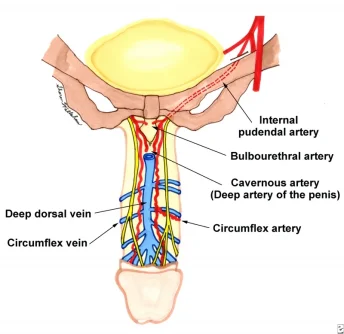
The same retrograde pressure wave that raises coronary flow doesn't stop at the heart. It also increases flow further downstream, including the arteries supplying the penis. That's the physiological basis for every study on EECP and erectile function: the same mechanism, just measured further from the heart.
Three of those four studies used the IIEF, the International Index of Erectile Function, a validated questionnaire that scores men across five domains including erectile function, desire, and satisfaction. The fourth used a shorter four-item questionnaire paired with Doppler ultrasound measurements of blood flow in the penis. Every study found statistically significant improvement on at least one measure after a course of EECP.
The largest and most cited study came in 2007, when Lawson and colleagues published a substudy of the International EECP Patient Registry. They tracked 120 men with severe coronary disease, most already past bypass or angioplasty and no longer candidates for further revascularization, through a standard 35-hour course. IIEF erectile function scores rose from 10.0 to 11.8 (p = 0.003) after treatment, and both intercourse satisfaction and overall satisfaction improved as well. The share of men reporting no ED complaint rose from 17.5 percent to 25 percent.
The same year, El-Sakka and colleagues published a two-part study on 44 men with coronary artery disease and ED. Part I found that men carrying more cardiovascular risk factors saw a smaller benefit, though overall satisfaction across the group stayed encouraging. Part II found that a second EECP course, or a shorter duration of heart disease, predicted a better response than a single course in men whose disease had lasted longer.
There's a subtler caveat too. Raeissadat's review noted that while the IIEF changes reached statistical significance, the actual point changes were small, and it's an open question whether a shift like Lawson's 10.0 to 11.8 is large enough for a man to notice in bed. That's a real, specific finding sitting on thin evidence.
This also isn't a competitor to what most ExcelMale members already use for ED. Trimix acts locally, at the injection site, within minutes. A PDE5 inhibitor acts systemically, but only for a few hours. EECP is different: it targets the vascular system as a whole, over a seven-week course, and any ED benefit shows up as a byproduct of treating angina, not as its own indication.
EECP also isn't appropriate for everyone with angina. A 2020 expert consensus paper lists uncontrolled arrhythmias that interfere with ECG timing, aortic or cerebral aneurysm, uncontrolled hypertension above 180/110, decompensated heart failure, and active bleeding disorders as reasons to hold off or choose a different treatment. Anyone considering EECP, for angina or for its ED effect, needs that screening done by a cardiologist first.
ExcelMale Consensus
EECP is a non-invasive treatment, FDA-cleared for chronic stable angina, that increases blood flow to the heart through pressure cuffs timed to the heartbeat. In the largest study on the topic, 120 men with severe coronary artery disease and erectile dysfunction saw their IIEF scores rise significantly after a 35-hour EECP course. The evidence is real but comes from four small, non-randomized studies that are decades old, and no insurer covers EECP for erectile dysfunction on its own, only for angina.
Key Takeaways
- EECP is FDA-cleared for chronic stable angina, not erectile dysfunction
- The largest ED-focused study (120 men, 2007) found erectile function scores improved significantly after a full course
- Published evidence covers 177 men across four studies from 1998 to 2007, last reviewed together in 2018
- No new EECP-and-ED study has appeared since that 2018 review
- Medicare and most private insurers cover EECP only for qualifying angina, explicitly excluding erectile dysfunction as a standalone indication
Picture a man in his mid-60s with three-vessel coronary artery disease, already past bypass and stenting, whose cardiologist starts him on a course of EECP for his angina. His chest pain eases, which is the point of the treatment. What rarely comes up in that visit: men in this exact situation, inside the largest study ever done on EECP and erectile dysfunction, also reported meaningfully better erections by the end of treatment.
What Is EECP and How Does It Work?
EECP stands for enhanced external counterpulsation, a non-invasive treatment the FDA cleared in 1995 for chronic stable angina, chest pain that persists despite medication and isn't a good fit for bypass or stenting. Three sets of pressure cuffs wrap around the calves, thighs, and buttocks. An ECG times the cuffs to the heartbeat: they inflate in sequence during diastole, the heart's relaxation phase, pushing blood backward toward the coronary arteries, then release right before the next heartbeat.That timing does two things. Inflating during diastole raises pressure in the coronary arteries when resistance there is lowest, so more blood reaches the heart muscle. Releasing before systole empties part of the aorta, so the heart pumps against less resistance on the next beat. Repeated over a full course, this appears to encourage new collateral vessels around blocked coronary arteries and improve how well the arterial lining functions.
The same retrograde pressure wave that raises coronary flow doesn't stop at the heart. It also increases flow further downstream, including the arteries supplying the penis. That's the physiological basis for every study on EECP and erectile function: the same mechanism, just measured further from the heart.
What Happens During an EECP Session?
A standard course is 35 one-hour sessions, usually five days a week over about seven weeks, though some clinics run two sessions a day to finish faster. Each session is outpatient. It's non-invasive: no needles, no incisions. You lie down, the cuffs go on your legs, and a technician monitors your ECG along with a finger sensor that tracks blood flow in real time. Some patients report leg soreness, bruising, or skin irritation from the cuffs, especially early in the course.What Does the Research Show for EECP and Erectile Dysfunction?
The full evidence base on EECP and erectile dysfunction was gathered in one place for the first time in 2018, when Raeissadat, Javadi, and Allameh published a narrative review in Vascular Health and Risk Management. They screened 208 records and found exactly four studies worth including, covering 177 men total.Three of those four studies used the IIEF, the International Index of Erectile Function, a validated questionnaire that scores men across five domains including erectile function, desire, and satisfaction. The fourth used a shorter four-item questionnaire paired with Doppler ultrasound measurements of blood flow in the penis. Every study found statistically significant improvement on at least one measure after a course of EECP.
What Did the Earliest Studies Find?
The first was small and mechanistic. In 1998, Froschermaier and colleagues gave EECP to 13 men with ED, one hour a day, five days a week, for four weeks. Using Doppler ultrasound after a prostaglandin injection, they measured an 87.5 percent increase in peak systolic flow and a 58.2 percent improvement in erection quality on their own four-item scale.The largest and most cited study came in 2007, when Lawson and colleagues published a substudy of the International EECP Patient Registry. They tracked 120 men with severe coronary disease, most already past bypass or angioplasty and no longer candidates for further revascularization, through a standard 35-hour course. IIEF erectile function scores rose from 10.0 to 11.8 (p = 0.003) after treatment, and both intercourse satisfaction and overall satisfaction improved as well. The share of men reporting no ED complaint rose from 17.5 percent to 25 percent.
The same year, El-Sakka and colleagues published a two-part study on 44 men with coronary artery disease and ED. Part I found that men carrying more cardiovascular risk factors saw a smaller benefit, though overall satisfaction across the group stayed encouraging. Part II found that a second EECP course, or a shorter duration of heart disease, predicted a better response than a single course in men whose disease had lasted longer.
What Are the Limits of This Evidence?
Every published study on EECP for ED comes from the same eleven-year window, 1998 to 2007, and Raeissadat's team found nothing newer to add when they checked again in 2018. None of the four studies used a control or sham group, so a placebo response can't be ruled out. Sample sizes topped out at 120 patients, and every participant had diagnosed coronary artery disease or angina; nobody has studied EECP for ED in men without heart disease.There's a subtler caveat too. Raeissadat's review noted that while the IIEF changes reached statistical significance, the actual point changes were small, and it's an open question whether a shift like Lawson's 10.0 to 11.8 is large enough for a man to notice in bed. That's a real, specific finding sitting on thin evidence.
Who Should Consider EECP for Erectile Dysfunction?
Every study on this topic enrolled men who already had angina or coronary artery disease severe enough to qualify for EECP on cardiac grounds. EECP isn't something you'd request as a standalone ED treatment. The erectile benefit shows up as a byproduct of treating angina, not as a treatment men pursue for ED on its own. If your ED has a vascular cause but you don't have qualifying heart disease, EECP has no published track record to point to, and options like Trimix or PDE5 inhibitors have a much larger evidence base for that situation.This also isn't a competitor to what most ExcelMale members already use for ED. Trimix acts locally, at the injection site, within minutes. A PDE5 inhibitor acts systemically, but only for a few hours. EECP is different: it targets the vascular system as a whole, over a seven-week course, and any ED benefit shows up as a byproduct of treating angina, not as its own indication.
Does Insurance Cover EECP for ED Alone?
No. Medicare's national coverage decision, and most private insurers who follow it, cover EECP only for disabling chronic stable angina, Canadian Cardiovascular Society Class III or IV, in patients a cardiologist has determined aren't good candidates for bypass or angioplasty. Several major payers state this explicitly. Blue Cross Blue Shield of North Carolina's policy names erectile dysfunction alongside heart failure and stroke as indications EECP is not covered for, citing insufficient evidence that it improves health outcomes for those uses.EECP also isn't appropriate for everyone with angina. A 2020 expert consensus paper lists uncontrolled arrhythmias that interfere with ECG timing, aortic or cerebral aneurysm, uncontrolled hypertension above 180/110, decompensated heart failure, and active bleeding disorders as reasons to hold off or choose a different treatment. Anyone considering EECP, for angina or for its ED effect, needs that screening done by a cardiologist first.
Frequently Asked Questions
Is EECP FDA-Approved for Erectile Dysfunction?
No. The FDA cleared EECP for chronic stable angina in 1995. Any improvement in erectile function is a secondary finding from angina-focused studies, not a separate approved use.How Long Does a Full EECP Course Take?
The standard course is 35 one-hour sessions, five days a week, over about seven weeks. Some clinics offer two sessions a day to shorten the calendar time.Can Men Without Heart Disease Consider EECP for ED?
There's no published research on EECP for ED in men without coronary artery disease or angina. Every study to date enrolled men who already qualified for EECP on cardiac grounds.Is EECP Safe to Combine With Trimix or PDE5 Inhibitors?
No published study has tested the combination directly. The mechanisms don't overlap since EECP works systemically while Trimix and PDE5 inhibitors act locally or briefly, but anyone combining them should clear it with both their cardiologist and prescribing provider first.Does Insurance Cover EECP If I Only Have ED, Not Angina?
No. Medicare and most private insurers cover EECP exclusively for qualifying chronic stable angina. Several payers explicitly list erectile dysfunction as a non-covered, investigational use.Conclusion
The most interesting number in the Lawson data is a quiet one: sexual desire barely moved while the physical mechanics of erectile function did. That split matters. EECP appears to change blood flow, not hormones or libido, which means it answers a narrower question than most men have in mind when they bring up ED treatment. If low testosterone or low desire is part of your picture too, that's a separate workup, and Why Viagra Fails 40% of Men walks through how vascular ED gets diagnosed properly before EECP would even be on the table. If a cardiologist has already floated EECP for your angina, TRT and Cardiovascular Disease covers how TRT and heart disease intersect in the same men who'd typically qualify for this treatment.Medical Disclaimer
This article is for educational purposes only and does not constitute medical advice. Always consult a qualified healthcare provider before starting or modifying any hormone therapy or medical treatment.
About ExcelMale
ExcelMale.com is a men's health community with more than 24,000 members and over 20 years of archives, founded by Nelson Vergel. Nelson is a chemical engineer with 34+ years on TRT and has served on NIH and FDA advisory panels. He is the author of Testosterone: A Man's Guide and Beyond Testosterone.Related ExcelMale Forum Discussions
- Why Viagra Fails 40% of Men, and What to Do When It Doesn't Work: how vascular ED gets diagnosed and why pills alone can miss the underlying cause.
- Is There a Role for Vascular Surgery in the Contemporary Management of ED?: penile revascularization surgery, a more invasive vascular option than EECP.
- TRT and Cardiovascular Disease: the evidence on testosterone therapy and heart disease risk in the same population EECP studies focus on.
- Erectile Dysfunction Explained to Patients and Doctors by a Specialist: a vascular surgeon's breakdown of penile Doppler assessment and vascular ED mechanisms.
- Why ED Pills Stop Working, and What to Do Next: ED as an early warning sign of cardiovascular disease.
- Tadalafil Use in Cardiovascular Disease: PDE5 inhibitor use specifically in men with heart disease.
- Trimix for Erectile Dysfunction, A Real-World Guide From Two Decades of Experience: the community's primary alternative for vascular ED that doesn't require cardiac qualifying criteria.
- How to Inject Trimix for Erectile Dysfunction: step-by-step technique for the most common non-EECP vascular ED treatment.
Key References
- Froschermaier SE, Werner D, Leike S, Schneider M, Waltenberger J, Daniel WG, Wirth MP. Enhanced External Counterpulsation as a New Treatment Modality for Patients with Erectile Dysfunction. Urologia Internationalis. 1998;61(3):168-171. https://doi.org/10.1159/000030315
- Lawson WE, Hui JC, Kennard ED, Soran O, McCullough PA, Kelsey SF; IEPR Investigators. Effect of Enhanced External Counterpulsation on Medically Refractory Angina Patients with Erectile Dysfunction. International Journal of Clinical Practice. 2007;61(5):757-762. https://doi.org/10.1111/j.1742-1241.2007.01328.x
- El-Sakka AI, Morsy AM, Fagih BI. Enhanced External Counterpulsation in Patients with Coronary Artery Disease-Associated Erectile Dysfunction. Part I: Effects of Risk Factors. Journal of Sexual Medicine. 2007;4(3):771-779. https://doi.org/10.1111/j.1743-6109.2007.00458.x
- El-Sakka AI, Morsy AM, Fagih BI. Enhanced External Counterpulsation in Patients with Coronary Artery Disease-Associated Erectile Dysfunction. Part II: Impact of Disease Duration and Treatment Courses. Journal of Sexual Medicine. 2007;4(5):1448-1453. https://doi.org/10.1111/j.1743-6109.2007.00550.x
- Raeissadat SA, Javadi A, Allameh F. Enhanced External Counterpulsation in Rehabilitation of Erectile Dysfunction: A Narrative Literature Review. Vascular Health and Risk Management. 2018;14:393-399. Enhanced external counterpulsation in rehabilitation of erectile dysfu | VHRM | Dove Medical Press
- Michaels AD, McCullough PA, Soran OZ, Lawson WE, Barsness GW, Henry TD, Linnemeier G, Ochoa A, Kelsey SF, Kennard ED. Primer: Practical Approach to the Selection of Patients for and Application of EECP. Nature Clinical Practice Cardiovascular Medicine. 2006;3(11):623-632. Primer: practical approach to the selection of patients for and application of EECP - Nature Reviews Cardiology
- Qin X, Deng Y, Wu D, Yu L, Huang R. Does Enhanced External Counterpulsation (EECP) Significantly Affect Myocardial Perfusion? A Systematic Review and Meta-Analysis. PLoS ONE. 2016;11(4):e0151822. Does Enhanced External Counterpulsation (EECP) Significantly Affect Myocardial Perfusion?: A Systematic Review & Meta-Analysis
- Lin S, Wang XM, Wu GF. Expert Consensus on the Clinical Application of Enhanced External Counterpulsation in Elderly People (2019). Aging Medicine. 2020;3(1):19-27. https://doi.org/10.1002/agm2.12097
- Jan R, Khan A, Zahid S, Sami A, Owais SM, Khan F, Asjad SJ, Jan MH, Awan ZA. The Effect of Enhanced External Counterpulsation (EECP) on Quality of Life in Patients with Coronary Artery Disease Not Amenable to PCI or CABG. Cureus. 2020;12(5):e7987. The Effect of Enhanced External Counterpulsation (EECP) on Quality of life in Patient with Coronary Artery Disease not Amenable to PCI or CABG
Last edited: