
Kyzatrex: The Complete Guide to Oral Testosterone Replacement Therapy
Curated By Nelson Vergel | ExcelMale.com | Updated January 2026
Curated By Nelson Vergel | ExcelMale.com | Updated January 2026
Introduction
What if you could restore your testosterone levels to normal without injections, messy gels, or painful pellet insertions? For millions of men with hypogonadism, that question has finally been answered with the FDA approval of Kyzatrex (testosterone undecanoate)—one of the first truly effective oral testosterone replacement therapies available in the United States.
For decades, the term "oral testosterone" carried a stigma in men's health circles, and for good reason. Earlier oral formulations like methyltestosterone were associated with serious liver toxicity, leading to their removal from the market and a lasting bias against oral testosterone among clinicians and patients alike. However, Kyzatrex represents a fundamentally different approach—utilizing a novel Self-Emulsifying Drug Delivery System (SEDDS) with phytosterol esters that bypasses the liver entirely through intestinal lymphatic absorption.
In this comprehensive guide, we'll examine everything men on TRT need to know about Kyzatrex: the clinical evidence behind its 96% efficacy rate, its unique effects on SHBG and free testosterone, how it compares to other oral testosterone options, practical dosing strategies from experienced clinicians, real-world community experiences, and important considerations for fertility preservation. Whether you're considering starting TRT for the first time or looking for an alternative to your current protocol, this guide will help you make an informed decision.
How Kyzatrex Works: The Science Behind Oral Testosterone Undecanoate
Understanding why Kyzatrex succeeds where previous oral testosterone formulations failed requires understanding the challenge of oral testosterone delivery. When testosterone is taken orally, it normally passes through the liver (first-pass metabolism) where it is rapidly broken down before reaching the bloodstream. This is why methyltestosterone had to be chemically modified—the 17-alpha-alkylation allowed it to survive liver passage, but that same modification caused serious hepatotoxicity.
The Lymphatic Bypass Mechanism
Kyzatrex takes an entirely different approach. The testosterone undecanoate molecule features a long-chain fatty acid ester (undecanoic acid, an 11-carbon chain) that makes it highly lipophilic. When combined with Kyzatrex's proprietary formulation containing phytosterol esters, the drug is absorbed through the intestinal lymphatic system rather than the hepatic portal vein. This means the testosterone enters the bloodstream without passing through the liver, completely avoiding first-pass metabolism.
Once in circulation, non-specific esterases cleave the undecanoic acid side chain, releasing free testosterone into the bloodstream. The undecanoic acid is pharmacologically inert and is metabolized through normal beta-oxidation, just like any dietary fatty acid. This elegant delivery system means Kyzatrex provides no hepatotoxic risk—a dramatic improvement over historical oral testosterone options.
Formulation Composition
Kyzatrex capsules contain testosterone undecanoate as the active ingredient, suspended in a specialized lipid matrix. The inactive ingredients include DL-alpha-tocopheryl acetate (Vitamin E) as an antioxidant stabilizer, phytosterol esters that aid lymphatic absorption, polyoxyl 40 hydrogenated castor oil as a surfactant, and propylene glycol monolaurate for enhanced stability. The gelatin capsule shell contains glycerin, purified water, sorbitol, and titanium dioxide.
Kyzatrex is available in three strengths: 100 mg, 150 mg, and 200 mg capsules. This range of dosing options allows for precise individualized therapy, with daily doses ranging from 100 mg once daily to 400 mg twice daily based on patient response.
Clinical Evidence: Efficacy and Safety Data
Kyzatrex received FDA approval in August 2022 based on robust phase III clinical trial data. The pivotal MRS-TU-2019EXT trial, a 6-month single-arm study published in Therapeutic Advances in Urology in 2024, enrolled 155 men with documented hypogonadism and demonstrated impressive efficacy and safety results.
Primary Efficacy Results
The primary endpoint was the percentage of patients achieving mean 24-hour plasma testosterone concentrations (Cavg) within the normal eugonadal range of 222-800 ng/dL at Day 90. Results showed that 87.8% of all treated patients (worst-case scenario calculation) achieved this endpoint, while 96.1% of patients who completed the study achieved normal testosterone levels. These efficacy rates exceeded FDA requirements and were consistent across all patient subgroups regardless of age, weight, or BMI.
Effects on Free Testosterone and SHBG
One of Kyzatrex's most clinically significant findings involves its effects on sex hormone-binding globulin (SHBG) and free testosterone. Unlike injectable testosterone formulations that may increase SHBG over time, Kyzatrex demonstrated a 30% reduction in mean SHBG levels and a two-fold increase in free testosterone (from 7.0 ng/dL to 14.1 ng/dL after 90 days). This is particularly beneficial for men who have normal total testosterone but symptoms of hypogonadism due to elevated SHBG—a population that often struggles to achieve symptomatic relief with other TRT modalities.
Pharmacokinetic Profile
Kyzatrex produces a predictable pharmacokinetic curve with twice-daily dosing. Testosterone levels peak at approximately 3-5 hours post-dose and return toward baseline by 10-12 hours. This short-acting profile is actually considered a clinical advantage by many experts, as it more closely mimics the body's natural circadian testosterone rhythm (which peaks in the morning) and may allow the hypothalamic-pituitary-gonadal (HPG) axis to remain partially active between doses.
Food Effects
While Kyzatrex must be taken with food to ensure adequate absorption through the lymphatic system, clinical data show that dietary fat content has minimal impact on efficacy. Studies comparing low-fat (16%), medium-fat (33%), and high-fat (45%) meals found that all produced therapeutic testosterone levels. According to Dr. Andrew Sun, a urologist specializing in men's health: "The studies suggest that low, medium, and high-fat diets result in similar testosterone absorption. While you don't need to count macros, I recommend taking it with something substantial for best results."
Safety Profile: Blood Pressure and Adverse Events
All testosterone replacement therapies carry some cardiovascular considerations, and Kyzatrex is no exception. The drug carries an FDA black box warning regarding potential blood pressure increases, though the clinical data suggest this effect is modest compared to other TRT formulations.
Ambulatory Blood Pressure Data
The MRS-TU-2019EXT trial included extensive ambulatory blood pressure monitoring (ABPM). Results showed mean increases from baseline in 24-hour systolic BP of 1.7 mmHg at Day 120 and 1.8 mmHg at Day 180. Diastolic BP increases were even smaller (<1 mmHg). Importantly, BP increases appeared to plateau by Day 120, with no further increases at Day 180.
For men not taking antihypertensive medications at baseline, the systolic BP increase was minimal (0.7-1.0 mmHg). Men already on blood pressure medications showed somewhat larger increases (3.1-3.4 mmHg systolic), highlighting the importance of BP monitoring in this population. Note: As of July 2025, the FDA removed the boxed warning for blood pressure increases from the Kyzatrex label, reflecting the favorable long-term safety data.
Hematocrit and Polycythemia
A key clinical advantage of Kyzatrex appears to be its favorable effect on hematocrit (HCT). Unlike injectable testosterone, which commonly causes polycythemia requiring phlebotomy or dose reduction, Kyzatrex shows minimal effect on HCT. In clinical trials, hematocrit did not significantly increase, and no patients discontinued therapy due to erythrocytosis. This makes Kyzatrex an attractive option for men who have experienced problematic HCT elevations on injectable TRT.
Other Adverse Events
The most common adverse reaction (≥2% of patients) was hypertension (2.6%). No drug-related serious adverse events occurred. Only one patient discontinued due to an adverse reaction (acne). Other reported adverse reactions included headache, arthralgia, diarrhea, and hemoglobin increases, though none at frequencies exceeding 2%. Importantly, no liver toxicity was observed—confirming the safety of the lymphatic absorption mechanism.
Kyzatrex vs. Other Oral Testosterone Options
The U.S. market currently has three FDA-approved oral testosterone undecanoate products: Jatenzo (approved 2019), Tlando (approved March 2022), and Kyzatrex (approved August 2022). While all three contain the same active ingredient and share the lymphatic absorption mechanism, there are meaningful differences in formulation, dosing, and practical considerations.
| Feature | Kyzatrex | Jatenzo | Tlando |
|---|---|---|---|
| FDA Approval | August 2022 | March 2019 | March 2022 |
| Available Strengths | 100, 150, 200 mg | 158, 198, 237 mg | 112.5 mg only |
| Starting Dose | 200 mg BID | 237 mg BID | 225 mg BID (fixed) |
| Titration Required | Yes, flexible | Yes | No (fixed dose) |
| Efficacy Rate | 88-96% | 87% | 80% |
| High-Fat Meal Needed | No | Yes | No |
| Cost (120 caps) | ~$179 (cash) | $900-2,400 | ~$900 |
| Insurance Coverage | Cash-pay only | Some coverage | Limited |
The key differentiator for Kyzatrex is its cash-pay pricing model. At approximately $179 per month regardless of dosage strength, it eliminates the insurance authorization hassles that plague Jatenzo prescriptions. As Dr. Sun notes: "Kyzatrex has taken a different approach by opting for a direct cash pay model, bypassing insurance. This simplifies access and reduces paperwork for both patients and physicians. It also eliminates the delays associated with insurance authorizations."
An authorized generic version, Undecatrex, was approved in October 2025, potentially offering even lower pricing while maintaining identical formulation to the brand-name product.
Practical Dosing Strategies and Clinical Protocols
The FDA-approved dosing for Kyzatrex begins at 200 mg twice daily with meals. Based on serum testosterone levels drawn 3-5 hours after the morning dose (at least 7 days after starting or dose adjustment), the dose can be titrated between a minimum of 100 mg once daily and a maximum of 400 mg twice daily (800 mg total daily dose).
High-Dose Starting Protocols
Some experienced clinicians have adopted higher starting doses for faster therapeutic effect. A 2024 retrospective review presented at the Sexual Medicine Society of North America found that starting at 400 mg twice daily was safe and effective, with high patient satisfaction. Dr. Andrew Sun of Urology Partners of North Texas explains: "Many patients attain greater symptomatic benefit at higher doses. I often start patients at this higher dose to achieve a more immediate therapeutic effect and assess safety and efficacy from the outset."
In that study of 27 hypogonadal men on 400 mg BID for 6 months, mean total testosterone increased from 263 to 798 ng/dL, SHBG dropped from 32.4 to 17.8 nmol/L, and calculated free testosterone rose from 7.2 to 26.7 ng/dL—all without significant hematocrit increases (44.9% to 47.4%). Importantly, FSH and LH were maintained at non-zero levels, suggesting some HPG axis preservation.
Optimizing Timing for Circadian Rhythm
The twice-daily dosing of Kyzatrex can be strategically timed to align with the body's natural testosterone rhythm. Dr. Sun recommends: "For example, many patients take their first dose with breakfast around 7 AM and their second dose after lunch around 1 PM. This helps maintain energy levels into the evening and aligns with their natural circadian rhythm. This dosing strategy can also help regulate sleep patterns by avoiding elevated testosterone levels late at night."

How to Get a Kyzatrex Prescription Through Thrive
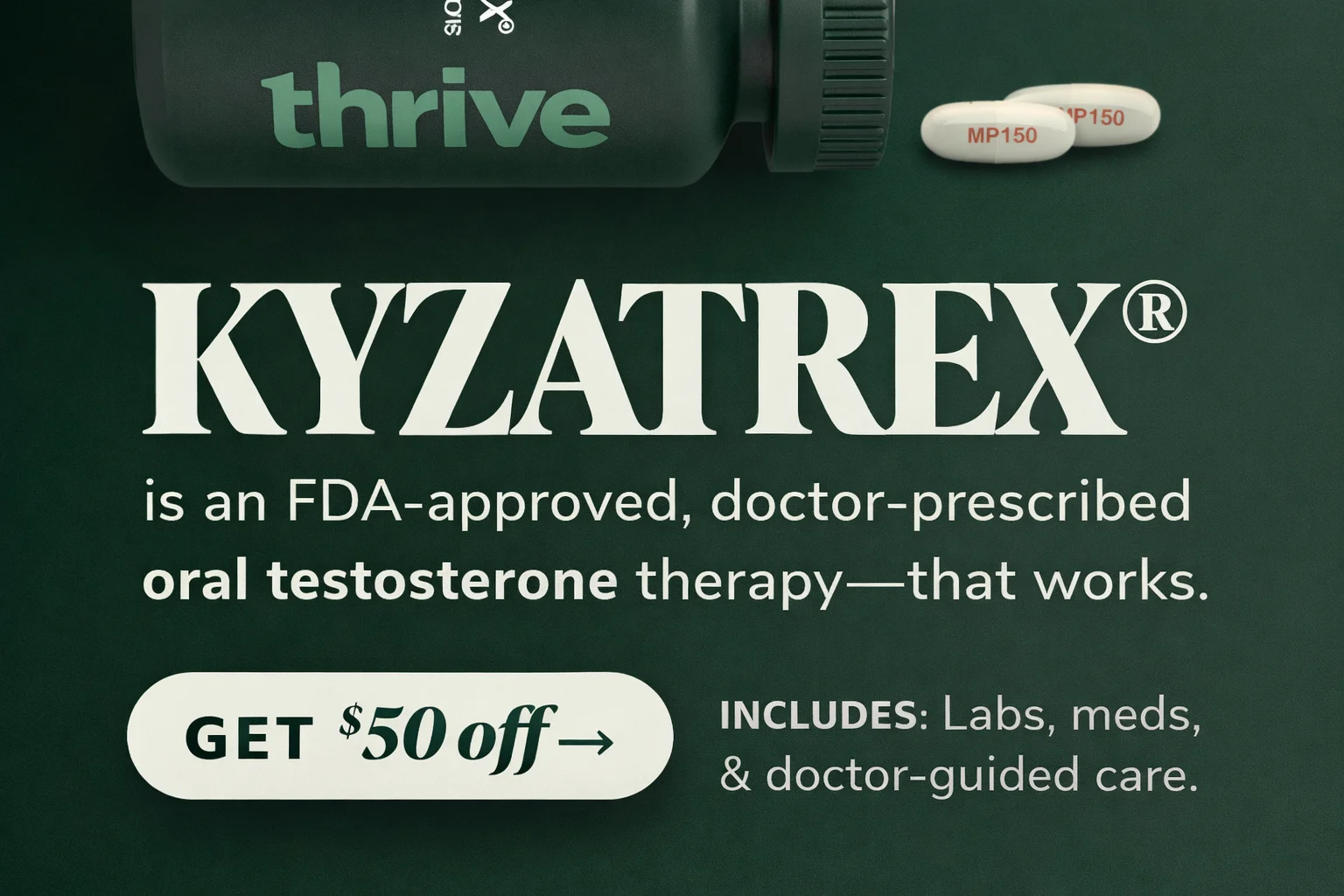
One of the most convenient ways to access Kyzatrex is through Thrive Wellness, a telehealth platform that specializes in hormone optimization. Thrive offers a streamlined, physician-guided process that includes comprehensive lab work, medical consultation, and medication—all bundled into a single monthly subscription.
What's Included with Thrive
For $249 per month, Thrive's testosterone program includes everything needed for comprehensive TRT management: your hormone panel (lab work), video consultation with a board-certified physician, your Kyzatrex medication shipped directly to your door, and ongoing physician oversight and support. There are no hidden fees—the lab work that would typically cost $200-400 out of pocket is included in your monthly subscription.
The Thrive Process: Step by Step
Step 1: Complete the Online Questionnaire — Start by filling out Thrive's 5-minute health questionnaire at thrivebetter.com/testosterone. You'll answer questions about your health history, current symptoms, lifestyle, and treatment goals. This information helps the medical team understand your unique situation before your consultation.
Step 2: Get Your Hormone Panel — After submitting your questionnaire and initial payment, Thrive will help you schedule your hormone panel at one of their partner lab locations near you. The lab work is included in your subscription price—all you have to do is show up. The comprehensive panel will assess your total testosterone, free testosterone, SHBG, and other relevant markers.
Step 3: Video Consultation with Your Physician — Once your lab results are available, you'll schedule a video consultation with a Thrive board-certified physician. This isn't a rushed 5-minute call—your doctor will take time to review your labs, discuss your symptoms, answer your questions, explain what to expect from treatment, and determine if Kyzatrex is appropriate for your situation. If you're not a candidate for testosterone therapy, the physician will discuss alternative options.
Step 4: Receive Your Medication — If your physician determines that Kyzatrex is right for you, your prescription will be filled and shipped directly to your home. Most patients receive their medication within 5-7 business days of their consultation.
Step 5: Ongoing Monitoring and Support — Your relationship with Thrive doesn't end when your medication arrives. Your treatment plan is continuously monitored and optimized based on follow-up lab work and how you're feeling. Your physician can adjust your dosing as needed, and you have access to the care team for questions or concerns that arise between visits.
Why Choose Thrive for Kyzatrex
Thrive prescribes Kyzatrex specifically because of its FDA approval, strong bioavailability, consistent results, and lack of liver toxicity. Their platform is designed around the unique characteristics of oral TRT—the need for regular monitoring, dose titration, and ongoing physician oversight.
The all-inclusive pricing model eliminates the common frustrations of traditional TRT: no surprise lab bills, no pharmacy runaround, no insurance prior authorizations, and no wondering whether your doctor is actually monitoring your treatment. For men who value convenience and comprehensive care, Thrive offers a modern approach to hormone optimization.
To get started or speak with a Thrive Wellness Advisor about whether Kyzatrex is right for you, visit thrivebetter.com/testosterone or schedule a call to discuss benefits, expected outcomes, fertility considerations, and any other questions you may have.
Fertility Considerations and HPG Axis Preservation
One of the most intriguing aspects of oral testosterone undecanoate therapy is its potential to preserve hypothalamic-pituitary-gonadal (HPG) axis function better than injectable testosterone. This has significant implications for men who wish to maintain fertility while treating hypogonadism.
Why Oral TU May Be Different
Injectable testosterone typically causes near-complete suppression of the HPG axis, leading to azoospermia in the majority of men (up to 98% with testosterone enanthate). The mechanism is straightforward: consistently elevated testosterone levels provide continuous negative feedback to the hypothalamus and pituitary, suppressing LH and FSH production and halting spermatogenesis.
Oral testosterone undecanoate's short half-life creates a different dynamic. According to Marius Pharmaceuticals: "KYZATREX safely restores T levels while allowing the hypothalamic-pituitary-gonadal (HPG) axis to remain active. T levels return to near baseline between KYZATREX doses, maintaining HPG axis function." This "pulsatile" delivery pattern more closely mimics natural testosterone secretion and may allow periodic LH/FSH release during trough periods.
Clinical Evidence for HPG Preservation
Clinical data support this theory. In a study of 27 men on Kyzatrex 400 mg BID, FSH and LH were maintained at non-zero levels: FSH decreased from 5.7 to 2.9 mIU/mL and LH from 3.3 to 1.9 mIU/mL—reduced but not suppressed to undetectable levels as typically occurs with injectable TRT. A novel combination approach using Kyzatrex with clomiphene citrate showed that patients achieved excellent testosterone levels (over 1,000 ng/dL) while maintaining FSH and LH levels near baseline, suggesting a promising strategy for men wanting both symptomatic relief and fertility preservation.
Important Caveats
Despite these encouraging findings, the FDA prescribing information still warns that "with large doses of exogenous androgens, including KYZATREX, spermatogenesis may be suppressed through feedback inhibition of pituitary FSH, possibly leading to adverse effects on semen parameters including sperm count." Men with active fertility goals should discuss this thoroughly with their physician. Ongoing studies are investigating the long-term effects on semen parameters and whether Kyzatrex truly offers a fertility-sparing TRT option.
Who Is the Ideal Candidate for Kyzatrex?
Based on clinical evidence and real-world experience, Kyzatrex may be particularly well-suited for certain patient populations:
Men with polycythemia/elevated hematocrit on injectable TRT: The minimal effect on HCT makes Kyzatrex an excellent alternative for men who have had to reduce injectable doses or undergo frequent phlebotomy due to elevated red blood cell counts.
Men with high SHBG and low free testosterone: The 30% SHBG reduction and twofold free T increase can be particularly beneficial for men with "normal" total testosterone who remain symptomatic due to elevated SHBG.
Needle-averse patients or those new to TRT: For men intimidated by injections or preferring a non-invasive option, oral therapy offers a significantly lower barrier to treatment initiation.
Men concerned about fertility preservation: While not definitively proven, the potential for reduced HPG axis suppression may appeal to younger men who want to maintain fertility options.
Men seeking convenience and discretion: Taking a capsule twice daily with meals is simpler than managing injection schedules, gel application, or pellet insertions.
Men frustrated with insurance barriers: The straightforward cash-pay model eliminates prior authorization delays and coverage denials.
Related ExcelMale Forum Discussions
Explore these community discussions for additional insights and real-world experiences:
- Optimizing Oral Testosterone Undecanoate (Kyzatrex) TRT: All You Need to Know — Comprehensive interview with Dr. Andrew Sun covering clinical protocols, dosing strategies, and patient selection
- KYZATREX (oral testosterone undecanoate) Updates — Ongoing thread tracking news, clinical data, and regulatory updates
- Interview with Shalin Shah, CEO of Marius Pharmaceuticals — Discussion of product development, misconceptions, and company vision
- Oral TRT Products: Jatenzo, Tlando, Kyzatrex & DITEST — Comparison thread discussing all available oral testosterone options
- Oral Testosterone Therapy: Complete Guide to Jatenzo, Tlando, Kyzatrex — Nelson Vergel's comprehensive overview of all FDA-approved oral testosterone products
- Updates in Testosterone Therapy - Oral T Combination Therapy — Discussion of combining oral TU with other therapies for optimized protocols
- FDA-Approved Oral Testosterone Therapy KYZATREX Now on Hims & Hers — News on expanded access through telehealth platforms
- Undecatrex: FDA-Approved Authorized Generic Version of Kyzatrex — Information on the newly available generic alternative
Key References
- Bernstein JS, Dhingra OP. A phase III, single-arm, 6-month trial of a wide-dose range oral testosterone undecanoate product. Ther Adv Urol. 2024;16:17562872241241864. PubMed
- White WB, Bernstein JS, Rittmaster R, Dhingra O. Effects of the oral testosterone undecanoate Kyzatrex on ambulatory blood pressure in hypogonadal men. J Clin Hypertens. 2021;23:1420-1430. PubMed
- Goldstein I, Chidambaram N, Dobs A, et al. Newer formulations of oral testosterone undecanoate: development and liver side effects. Sex Med Rev. 2025;13(1):33-40. PubMed
- Vo J, Yoon G, Sun AY. Initiating high-dose oral testosterone undecanoate therapy in hypogonadal men: safety, efficacy, and patient satisfaction. Presented at: 2024 SMSNA Fall Scientific Meeting. Scottsdale, AZ. Urology Times
- Miner M, Wang C, Kaminetsky J, et al. Treatment of Symptomatic Male Hypogonadism with New Oral Testosterone Therapies: A Comparative Review. Medicines. 2025;13(1):1. MDPI
- Herati AS, et al. Preserving spermatogenesis in testosterone deficiency: innovations in replacement and stimulatory therapies. Transl Androl Urol. 2024. PMC
- KYZATREX (testosterone undecanoate) Prescribing Information. Marius Pharmaceuticals. 2025. DailyMed
- Bhasin S, Brito JP, Cunningham GR, et al. Testosterone Therapy in Men With Hypogonadism: An Endocrine Society Clinical Practice Guideline. J Clin Endocrinol Metab. 2018;103(5):1715-1744. PubMed
Medical Disclaimer
This article is for informational and educational purposes only and is not intended as medical advice. The information provided should not be used for diagnosing or treating any health condition. Always consult with a qualified healthcare provider before starting, changing, or stopping any medication or treatment. Individual responses to testosterone replacement therapy vary significantly, and what works for one person may not be appropriate for another. ExcelMale.com and the author are not responsible for any actions taken based on the information in this article.
About ExcelMale
ExcelMale.com is the leading online community for men's health, with over 24,000 members and more than 20 years of archived discussions on testosterone replacement therapy, hormone optimization, and related topics. Founded by Nelson Vergel, author of Testosterone: A Man's Guide and Beyond Testosterone, the forum provides evidence-based information and peer support for men navigating the complexities of hormone health.
SUMMARY VIDEO:
Last edited: