ExcelMale Consensus: Clomid for men (clomiphene citrate) raises testosterone by prompting the pituitary to release more LH and FSH, so the testes keep making their own testosterone and sperm. In a 400-man study, 88% of men who took it for more than three years reached normal testosterone levels. It fits men with low or normal LH who want to protect fertility. It does not fit men whose testes have already failed.
Key Takeaways
- Clomid is prescribed off-label for men. The FDA approved it only for ovulation problems in women.
- Published protocols start at 25 mg every other day and go up to 50 mg per day.
- Testosterone rises within weeks. Sperm counts need three months or longer.
- In a 2022 meta-analysis of 1,642 men, side effects showed up in fewer than 10% of study populations.
- Clomid raises estradiol and SHBG along with testosterone, so free testosterone can lag behind total.
- Enclomiphene is one of the two isomers inside Clomid. It is covered in its own section below.
In a 2014 Baylor College of Medicine comparison, men on Clomid finished at a median testosterone of 504 ng/dL, while men on testosterone injections finished above 1,000 ng/dL. Both groups reported similar overall satisfaction on the qADAM questionnaire (Ramasamy 2014). That result explains why Clomid keeps coming up on the ExcelMale forum: a man can feel better at a mid-range number and keep his fertility.
What Is Clomid and How Does It Work in Men?
Clomid is a selective estrogen receptor modulator (SERM) that blocks estrogen receptors in the hypothalamus and pituitary. The brain reads that block as low estrogen and responds by releasing more luteinizing hormone (LH) and follicle-stimulating hormone (FSH). LH tells the Leydig cells to make testosterone. FSH supports sperm production.
Testosterone replacement works in the opposite direction. Injected or topical testosterone shuts down LH and FSH, and sperm production usually falls with them. Clomid has been used for male hypogonadism since the 1970s for this reason (Wheeler 2019).
Who Is a Good Candidate for Clomid?
The best candidate is a man with low testosterone, low or normal LH, and a wish to have children now or later. That lab pattern is called secondary hypogonadism: the testes can still work, and the signal from the pituitary is weak. Our guide to the causes of secondary hypogonadism explains how to tell the two types apart.
In a 2023 Dutch study of 153 men, an LH in the lower normal range before treatment predicted a better testosterone response (Huijben 2023). Men with high LH already have a pituitary that is shouting at testes that can't answer. Clomid adds little there.
The Endocrine Society recommends against starting testosterone therapy in men planning fertility in the near term (Bhasin 2018). Clomid and hCG are the usual alternatives for those men. The hCG, Clomid and Fertility index lists the main ExcelMale threads on both.
What Is the Usual Clomid Dosage for Men?
Most published protocols start at 25 mg every other day or 25 mg daily and adjust by follow-up labs. No dose has been formally established for men because the drug was never approved for them.
| Source | Starting dose | Adjustment | Result |
|---|---|---|---|
| Katz 2012, 86 men, mean age 29 | 25 mg every other day | Up to 50 mg every other day, target 550 ng/dL | 70% stayed on 25 mg every other day |
| Common clinical practice | 25 mg daily or every other day | Up to 50 mg daily | Varies. Adjusted by testosterone, estradiol and symptoms |
| Huijben 2023, 153 men | Clinic protocol | By labs | Testosterone rose from 9 to 16 nmol/L (about 260 to 460 ng/dL) |
Lower doses are common in practice. One ExcelMale member reported total testosterone of 500 to 600 ng/dL on 12.5 mg per day. More is not always better: higher doses push estradiol and SHBG up further.
How Long Does Clomid Take to Work in Men?
LH and testosterone rise within the first few weeks, and most clinicians recheck labs at four to six weeks. Sperm takes longer. A full cycle of sperm production runs about 74 days, so a semen analysis before three months tells you little. Some men need far longer, as discussed in this thread on clomiphene taking up to 9 months to restore sperm count.
The effect holds over time. In Huijben's cohort, men who stayed on treatment still had higher testosterone after eight years.
What Are the Side Effects of Clomid in Men?
The most reported side effects are mood changes, blurred vision and breast tenderness. In the Krzastek study, 8% of men treated for more than three years reported a side effect, and no serious adverse event occurred in any of the 400 patients (Krzastek 2019).
Visual symptoms deserve respect. Blurring, floaters or flashes are a reason to stop the drug and call your doctor.
Why Do Some Men Feel Worse on Clomid Despite Higher Testosterone?
Clomid raises SHBG and estradiol along with total testosterone, and that can leave free testosterone nearly unchanged. The Huijben meta-analysis confirmed increases in both (Huijben 2022). This comes up constantly in ExcelMale. One member saw total testosterone climb from about 600 to 1,500 ng/dL while SHBG went from 50 to 90 nmol/L, and he felt no better. Ask for free testosterone and SHBG on every follow-up panel.
How Does Clomid Compare With TRT and Enclomiphene?
Clomid preserves sperm production and TRT suppresses it. That is the main difference. TRT reaches higher testosterone levels, and men on injections reported higher libido scores than men on Clomid in the Ramasamy comparison.
| Clomid | Enclomiphene | Testosterone injections | |
|---|---|---|---|
| FDA status for men | Off-label | Not FDA-approved | Approved |
| LH and FSH | Increase | Increase | Suppressed |
| Sperm production | Preserved | Preserved | Usually reduced |
| Median testosterone on treatment | 504 ng/dL (Ramasamy 2014) | Normal range at 16 weeks (Kim 2016) | Above 1,000 ng/dL (Ramasamy 2014) |
| Estradiol | Rises | Rises | Rises with dose |
| Main drawback | Mood and visual effects, SHBG rise | Less long-term data | Infertility, testicular shrinkage |
What Is Enclomiphene and Is It Better Than Clomid?
Enclomiphene is the isomer in Clomid that does the estrogen blocking. You will also see it misspelled as "enclophamine." Clomid is a mix of two isomers: roughly 62% enclomiphene and 38% zuclomiphene. Zuclomiphene has weak estrogen-like activity and a much longer half-life, so it builds up over months. Many clinicians suspect it drives the mood side effects.
In two phase III trials, enclomiphene restored normal testosterone and kept sperm concentration in the normal range over 16 weeks, while testosterone gel caused a marked drop in sperm production (Kim 2016). An earlier phase II trial tested 12.5 mg and 25 mg daily doses with the same pattern (Wiehle 2014).
No large randomized trial has compared enclomiphene with Clomid head to head. The FDA has not approved enclomiphene, and US access has been through compounding pharmacies, so confirm current availability with your prescriber. Members share their dosing and lab results in this enclomiphene 12.5 mg experience thread.
Can You Take Clomid With Testosterone?
Taking Clomid on top of TRT does little, because injected testosterone suppresses the pituitary signal that Clomid depends on. Mike Gaiso walks through the reasoning in Clomid and Testosterone: Why They Don't Work Together. Men on TRT who want to keep testicular function usually add hCG instead.
Which Lab Tests Show Whether Clomid Is Working?
Total testosterone, free testosterone, LH, FSH, estradiol and SHBG at four to six weeks show whether Clomid is working. LH and FSH should rise. If they rise and testosterone doesn't, the testes are the limit and Clomid is the wrong tool.
Add a semen analysis at three months if fertility is the goal. You can order a testosterone, LH and FSH panel without a doctor's visit and take the results to your prescriber.
Frequently Asked Questions
Is Clomid FDA-approved for men?
No. Clomid is FDA-approved only for ovulatory dysfunction in women. Doctors prescribe it to men off-label for low testosterone and infertility.Does Clomid increase sperm count?
Clomid raises FSH and LH, which support sperm production, and several studies show improved semen parameters. Results vary by man, and a few men see no change.What happens when you stop Clomid?
Testosterone usually drifts back toward its old baseline because the underlying cause is still there. One ExcelMale member went from 500 to 600 ng/dL on treatment to about 180 ng/dL after stopping.Can you stay on Clomid long term?
The longest published follow-up runs to eight years with sustained testosterone levels. Krzastek's study found no difference in safety between men treated for more or less than three years.Does Clomid raise estradiol in men?
Yes. Estradiol rose significantly in the Krzastek study and in the 2022 meta-analysis. The rise follows the increase in testosterone.Related ExcelMale Forum Discussions
- HCG, Clomid and Fertility: Start Here (Index). The hub for fertility and restart threads.
- Clomid and Testosterone: Why They Don't Work Together. Why stacking the two fails.
- Advice Needed After 6 Months of Enclomiphene 12.5 mg. A member's labs and symptoms on enclomiphene.
- Clomiphene May Take 9 Months to Fully Restore Sperm Count. Realistic fertility timelines.
- hCG, Clomid and Others for Fertility, PCT or Low T. The full subforum.
Key References
- Krzastek SC, et al. Long-Term Safety and Efficacy of Clomiphene Citrate for the Treatment of Hypogonadism. J Urol. 2019;202(5):1029-1035. doi:10.1097/JU.0000000000000396
- Huijben M, et al. Clomiphene citrate for men with hypogonadism: a systematic review and meta-analysis. Andrology. 2022;10(3):451-469. doi:10.1111/andr.13146
- Huijben M, et al. Clomiphene citrate: A potential alternative for testosterone therapy in hypogonadal males. Endocrinol Diabetes Metab. 2023;6(3):e416. doi:10.1002/edm2.416
- Wheeler KM, et al. Clomiphene Citrate for the Treatment of Hypogonadism. Sex Med Rev. 2019;7(2):272-276. doi:10.1016/j.sxmr.2018.10.001
- Katz DJ, et al. Outcomes of clomiphene citrate treatment in young hypogonadal men. BJU Int. 2012;110(4):573-578. doi:10.1111/j.1464-410X.2011.10702.x
- Ramasamy R, et al. Testosterone supplementation versus clomiphene citrate for hypogonadism: an age matched comparison of satisfaction and efficacy. J Urol. 2014;192(3):875-879. doi:10.1016/j.juro.2014.03.089
- Kim ED, et al. Oral enclomiphene citrate raises testosterone and preserves sperm counts in obese hypogonadal men, unlike topical testosterone. BJU Int. 2016;117(4):677-685. doi:10.1111/bju.13337
- Wiehle RD, et al. Enclomiphene citrate stimulates testosterone production while preventing oligospermia. Fertil Steril. 2014;102(3):720-727. doi:10.1016/j.fertnstert.2014.06.004
- Bhasin S, et al. Testosterone Therapy in Men With Hypogonadism: An Endocrine Society Clinical Practice Guideline. J Clin Endocrinol Metab. 2018;103(5):1715-1744. doi:10.1210/jc.2018-00229
One Last Point Before You Start
Get a baseline semen analysis before the first pill, even if children are years away. Most men skip it. Without a baseline, a low count at month six could be the drug not working or a problem that was always there, and nobody can tell which. If you are weighing Clomid against hCG, the fertility index thread is the next read, and the Gaiso thread covers what to do if you are already on TRT.
Medical Disclaimer: This article is for educational purposes only and does not constitute medical advice. Always consult a qualified healthcare provider before starting or modifying any hormone therapy or medical treatment.
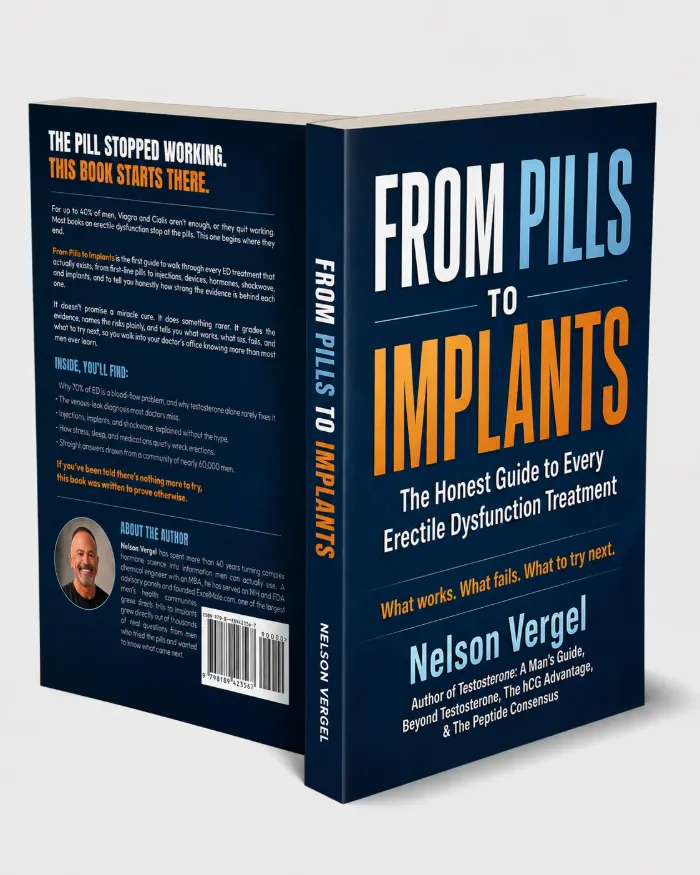
By Nelson Vergel | B.S. Chemical Engineering, MBA | Founder, ExcelMale.com | 34+ years on TRT | NIH and FDA advisory panel service | Author: Testosterone: A Man's Guide, Beyond Testosterone, The hCG Advantage, and From Pills to Implants. Updated November 2026.
About ExcelMale: ExcelMale.com is a men's health community founded by Nelson Vergel, with more than 24,000 members and over 20 years of archives covering testosterone replacement, hormone optimization, fertility, and men's sexual health.
Last edited: