

Nelson Vergel
Founder, ExcelMale.com
This video about how a full body dual-energy x-ray absorptiometry (DEXA) scan works as the best way to measure body composition. However, few clinics provide it since they only use DEXA to measure bone density in the lower back and pelvis. It required special calibration for a full body scan. Talk to your doctor is he can find a local clinic that can do a full body DEXA scan. Your insurance may not pay for it. Out of pocket cost may be close to $200. You only need to do it every 2-3 years for bone density if you are over 50. If you are a bodybuilder that expects dramatic body changes in a few months, then every 6 months to a year would be OK. The amount of X ray radiation you are exposed to is equivalent to your exposure in a transatlantic flight.
The scan classifies the body into three broad components:

The person lies still with the feet together and the arms held close to the sides like a soldier. The scan takes approximately three to five minutes, during which the subject breathes normally and avoids turning the head while the scanning arm passes over the body.
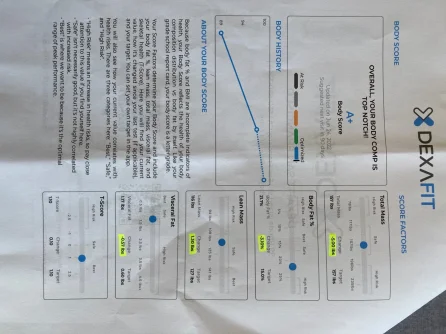
The report contains more than one fat-percentage column, but the technician advised ignoring the first column because it includes bone marrow. Bone marrow contains fat that is physiologically necessary and should not be treated as expendable body fat.
The technician explained the total mathematically: fat mass plus lean or muscle mass plus bone mineral content equals the reported body weight. Thus, the very low 6.2% body-fat result reflected approximately 10.4 lb of fat relative to 148.5 lb of lean tissue and 8.3 lb of bone mineral content.
The scan’s fat-distribution image showed essentially no obvious red or yellow fat zones, which the technician associated with higher fat amounts. A small area near the ankles was attributed not to substantial ankle fat but to the limited non-bone tissue in that region.
Ctrl+ScrollorPinch
Nuñez’s bone-density result was 3.4, substantially above the stated young-adult reference value. The technician connected this result with resistance training because exercises that make muscles pull on bones stimulate the body to build more bone; by contrast, weightless activities such as swimming do not provide the same mechanical loading.
The discussion also presented age 30 as approximately the point at which people reach their greatest bone mass, after which maintaining a strong starting reserve becomes valuable. Nuñez’s unusually high result was described metaphorically as extra bone-density “in the bank,” providing a larger reserve as bone density later declines.
A separate classification system, based on National Institutes of Health ideals for men and women up to age 39, placed Nuñez just below the category labeled athletic. The technician argued that this category was so uncommon that it represented people training seriously to compete, comparable to professional athletes, rather than ordinary recreationally fit people.
The categories were characterized as follows:
The technician also noted that some individuals several percentage points below the athletic category can still be completely healthy, while others who reach very low body-fat levels may be unhealthy, including people with anorexia. Therefore, a category or percentage alone cannot determine health.
The discussion also contrasted male and female body-fat requirements: women generally need a higher minimum because estrogen supports bone health, and insufficient body fat can contribute to faster declines in bone density. The technician stated that women should not generally be below 20% in the referenced framework, while men should not generally be above 20% for the comparison being discussed.
Nuñez’s scan provided unusually precise-sounding numbers—6.2% body fat, 10.4 lb of fat, 148.5 lb of lean tissue, 8.3 lb of bone mineral content, and a 167 lb total weight—but the technician still interpreted those numbers alongside health, hormonal considerations, bone density, and how the athlete actually felt.
Why the Dexa Scan Was Used
Coach Alberto Nuñez chose a dual-energy X-ray absorptiometry (DEXA) scan, a body-composition test that uses X-rays, primarily out of curiosity about his body-fat percentage. He regarded DEXA as probably the most accurate available method under most circumstances, while emphasizing that numerical results are interesting rather than the ultimate purpose of bodybuilding.The scan classifies the body into three broad components:
- Bone
- Fat
- Muscle or lean tissue
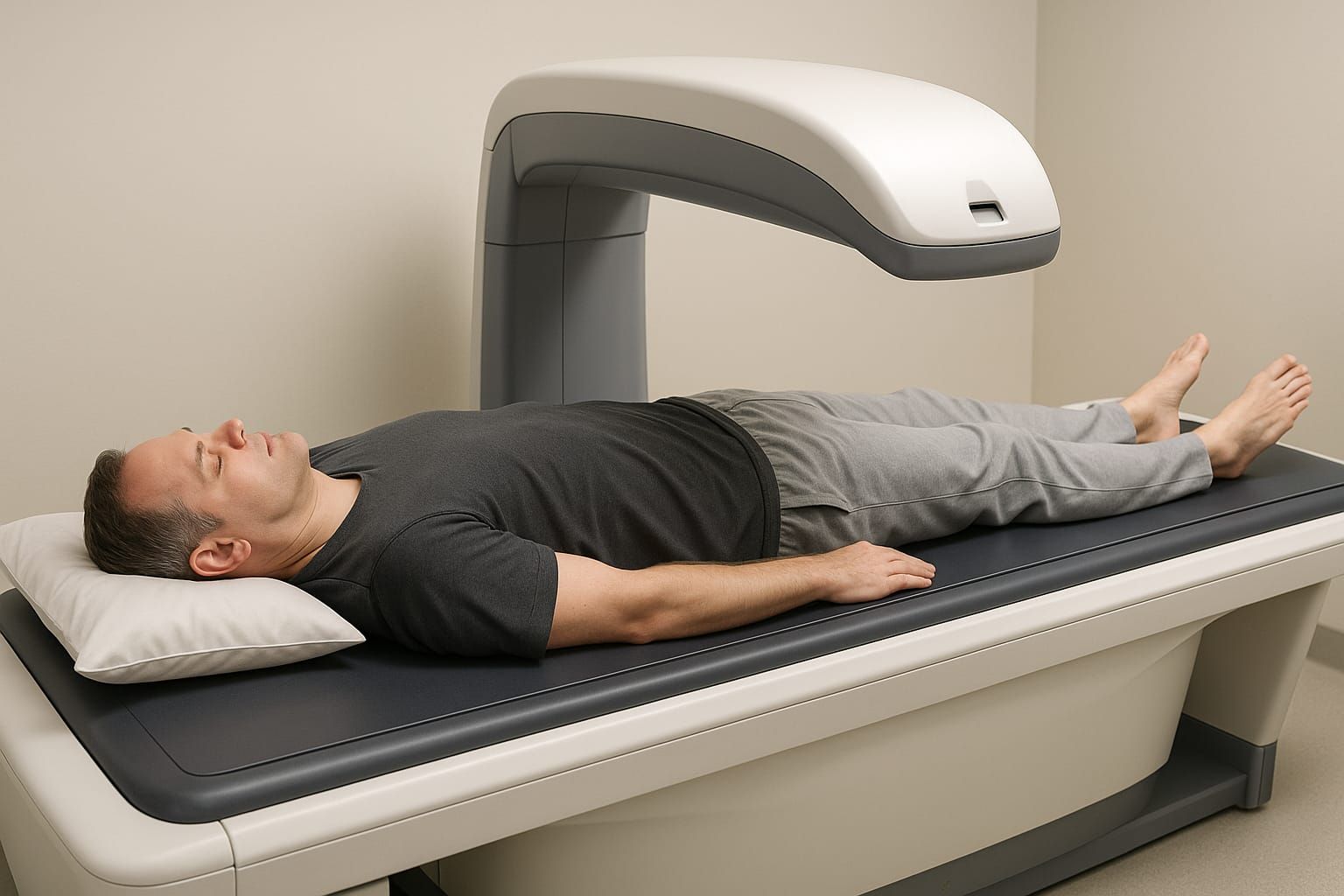
The person lies still with the feet together and the arms held close to the sides like a soldier. The scan takes approximately three to five minutes, during which the subject breathes normally and avoids turning the head while the scanning arm passes over the body.
How the Scan Divides the Body
The DEXA report separates the body into anatomical regions using dividing lines on the scan image. These regions allow the machine to compare fat and lean tissue in different parts of the body rather than reporting only one whole-body value.| Region | Definition in the scan |
|---|---|
| Arms and legs | The right and left limbs are measured separately. |
| Trunk | The central body region extending from the neck to the hip line. |
| Android region | The abdominal area, described as a belt-like zone across the upper midsection. |
| Gynoid region | The region around the hips and buttocks. |
Reported Body-Composition Results
Nuñez’s scan reported the following values:| Component | Result |
|---|---|
| Total body fat | 6.2% |
| Fat mass | 10.4 lb |
| Lean or muscle mass | 148.5 lb |
| Bone mineral content | 8.3 lb |
| Total body weight | 167 lb |
The scan’s fat-distribution image showed essentially no obvious red or yellow fat zones, which the technician associated with higher fat amounts. A small area near the ankles was attributed not to substantial ankle fat but to the limited non-bone tissue in that region.
How DEXA Produces the Body-Composition Result
Ctrl+ScrollorPinch
Bone Density and the Meaning of the T-Score
The scan also assessed bone density using a T-score, a comparison with the average bone density of young adults. The technician stated that a typical 30-year-old reference value is a T-score of zero.Nuñez’s bone-density result was 3.4, substantially above the stated young-adult reference value. The technician connected this result with resistance training because exercises that make muscles pull on bones stimulate the body to build more bone; by contrast, weightless activities such as swimming do not provide the same mechanical loading.
The discussion also presented age 30 as approximately the point at which people reach their greatest bone mass, after which maintaining a strong starting reserve becomes valuable. Nuñez’s unusually high result was described metaphorically as extra bone-density “in the bank,” providing a larger reserve as bone density later declines.
Abdominal Fat: Subcutaneous Versus Visceral
The abdominal analysis distinguished between two types of fat:- Subcutaneous fat is located beneath the skin, over the muscles of the front and back of the body.
- Visceral fat is deeper in the abdomen, surrounding internal organs. Excess visceral fat was associated in the discussion with diabetes and other health problems.
Interpreting the Comparison Categories
The report compared Nuñez with reference populations, including United States Caucasian men for some bone-density comparisons. The technician cautioned that comparing body fat with the general U.S. population would not be especially useful because that population includes many people with high body weight and would make an extremely lean individual appear better than average without necessarily providing a meaningful athletic standard.A separate classification system, based on National Institutes of Health ideals for men and women up to age 39, placed Nuñez just below the category labeled athletic. The technician argued that this category was so uncommon that it represented people training seriously to compete, comparable to professional athletes, rather than ordinary recreationally fit people.
The categories were characterized as follows:
| Category discussed | Practical interpretation given |
|---|---|
| Athletic | Very uncommon; associated with people training to compete. |
| Fit | People who generally feel good in a bathing suit and may have visible abdominal definition; the technician considered the label imperfect. |
| Healthy | A broader range representing acceptable health rather than extreme leanness. |
Essential Fat and the Health Boundary
The technician cautioned that men should not reduce body fat much below the stated essential-fat level of approximately 6%, because hormonal function may worsen at levels below that point. Nuñez’s result of 6.2% was therefore presented as approximately the leanest level he could likely maintain while still feeling healthy and functioning well.The discussion also contrasted male and female body-fat requirements: women generally need a higher minimum because estrogen supports bone health, and insufficient body fat can contribute to faster declines in bone density. The technician stated that women should not generally be below 20% in the referenced framework, while men should not generally be above 20% for the comparison being discussed.
Main Lesson for Bodybuilding
The central takeaway was that bodybuilding is a subjective sport: numerical measurements such as body-fat percentage, lean mass, and bone density can be interesting and informative, but the visible physique and overall presentation remain the practical focus.Nuñez’s scan provided unusually precise-sounding numbers—6.2% body fat, 10.4 lb of fat, 148.5 lb of lean tissue, 8.3 lb of bone mineral content, and a 167 lb total weight—but the technician still interpreted those numbers alongside health, hormonal considerations, bone density, and how the athlete actually felt.
Last edited: