

Nelson Vergel
Founder, ExcelMale.com
Groundbreaking study that included a vulnerable population previously excluded from studies.
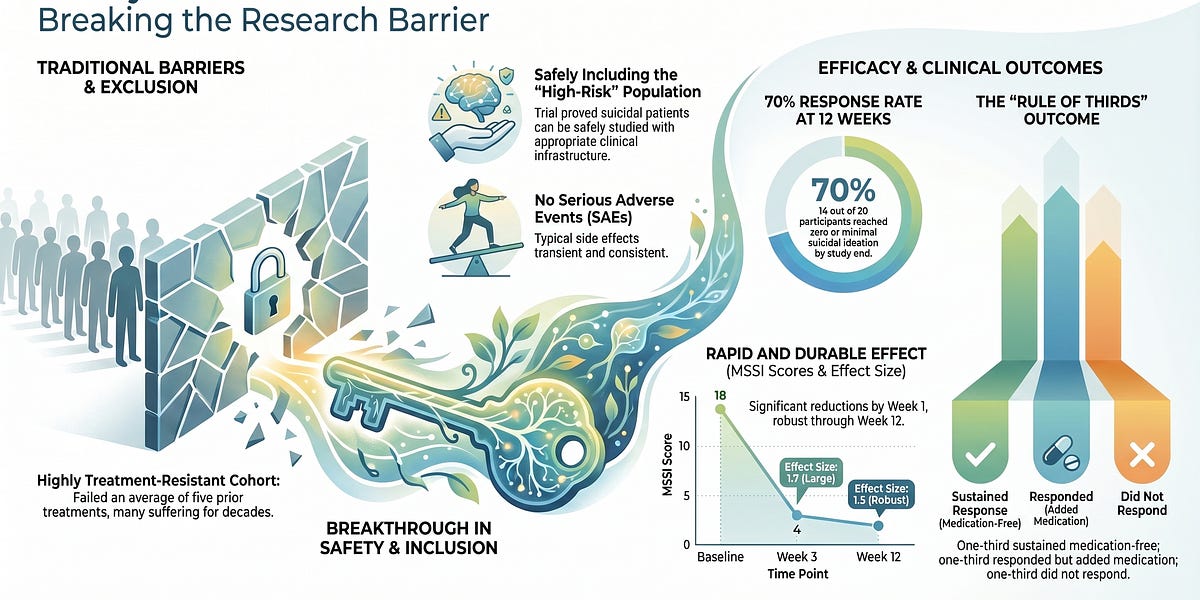
Dr. Scott Aaronson and Dr. Andrew van der Vaart discuss their Journal of Clinical Psychiatry open-label, single-arm 12-week trial testing a single 25 mg dose of COMP360 psilocybin with psychological support in 20 adults with chronic active suicidal ideation and major depressive disorder. Participants were highly treatment-resistant, tapering off psychotropics before dosing and completing preparation, an ~8-hour dosing session, and integration. Suicidal ideation (MSSI) dropped substantially by week 3 (primary endpoint) and remained reduced through week 12, with 70% reporting minimal or zero ideation at endpoint; depression (MADRS) also improved and correlated with MSSI changes. No serious adverse events occurred, though two participants had increased suicidal ideation. Exploratory signals linked non-response to prior ECT and greater hopelessness/pessimism, highlighting the need for controlled trials and responder prediction.
00:00 Study Introduction
01:10 Why Suicidality Research Lags
02:27 Trial Design Overview
03:50 Participants and Treatment Protocol
05:24 Efficacy Results
07:59 Durability and Med Changes
09:08 Safety Findings
10:04 Who Responds and Why
12:25 Clinical Takeaways
15:54 Next Steps and Closing
More details:
First Study: Psilocybin for Chronic Suicidal Ideation.
A Landmark Trial Treats the Population Psychiatry Left Behind
 open.substack.com
Dr. Scott Aaronson and Dr. Andrew van der Vaart discuss their Journal of Clinical Psychiatry open-label, single-arm 12-week trial testing a single 25 mg dose of COMP360 psilocybin with psychological support in 20 adults with chronic active suicidal ideation and major depressive disorder. Participants were highly treatment-resistant, tapering off psychotropics before dosing and completing preparation, an ~8-hour dosing session, and integration. Suicidal ideation (MSSI) dropped substantially by week 3 (primary endpoint) and remained reduced through week 12, with 70% reporting minimal or zero ideation at endpoint; depression (MADRS) also improved and correlated with MSSI changes. No serious adverse events occurred, though two participants had increased suicidal ideation. Exploratory signals linked non-response to prior ECT and greater hopelessness/pessimism, highlighting the need for controlled trials and responder prediction.
00:00 Study Introduction
01:10 Why Suicidality Research Lags
02:27 Trial Design Overview
03:50 Participants and Treatment Protocol
05:24 Efficacy Results
07:59 Durability and Med Changes
09:08 Safety Findings
10:04 Who Responds and Why
12:25 Clinical Takeaways
15:54 Next Steps and Closing
More details:
First Study: Psilocybin for Chronic Suicidal Ideation.
A Landmark Trial Treats the Population Psychiatry Left Behind
First Study: Psilocybin for Chronic Suicidal Ideation.
A Landmark Trial Treats the Population Psychiatry Left Behind
open.substack.com